Introduction
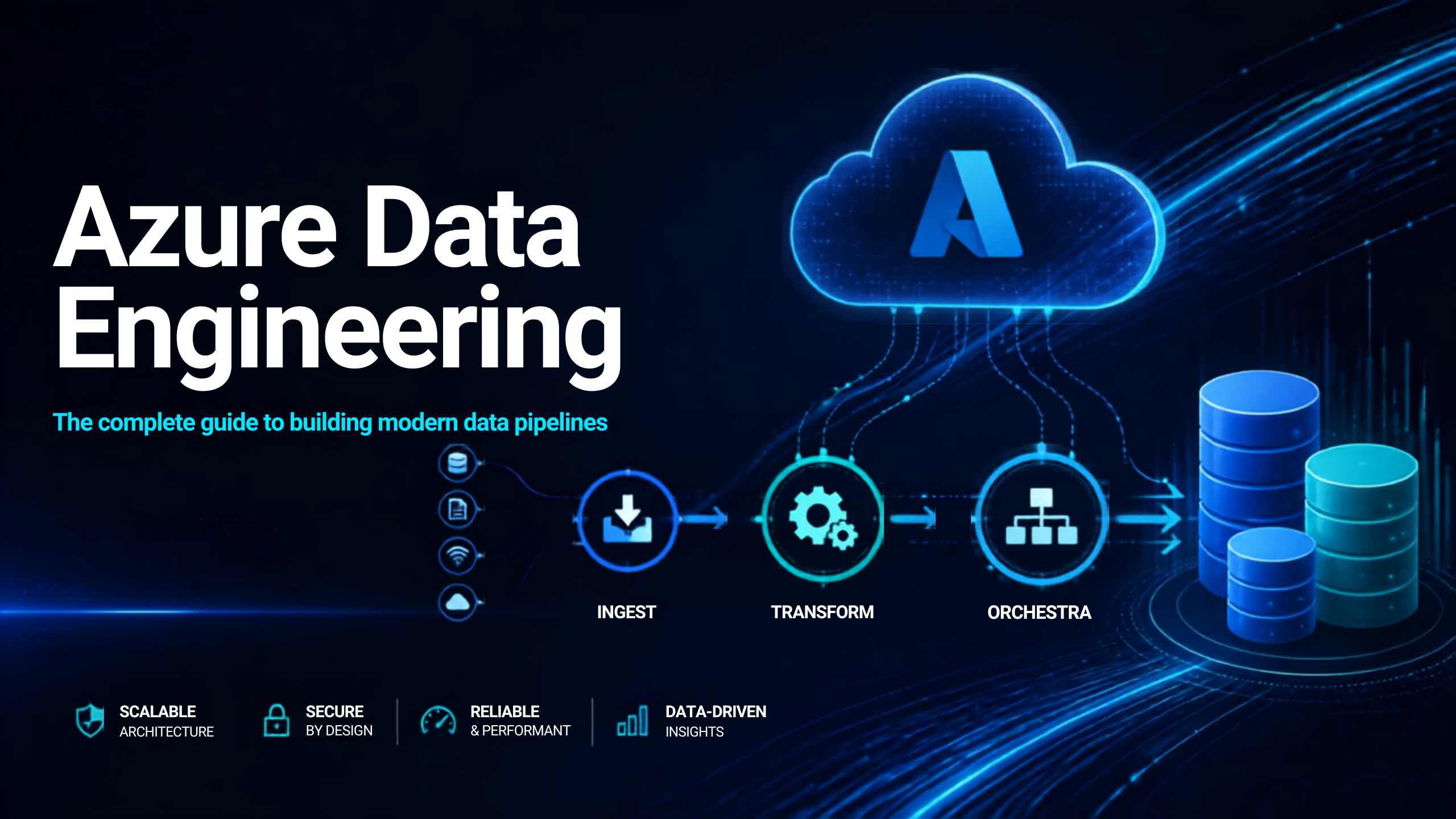
In today’s digital era, organizations generate massive volumes of data from websites, mobile applications, IoT devices, social media, and enterprise systems. Transforming this raw data into meaningful insights requires scalable, reliable, and secure data engineering solutions.
Azure Data Engineering leverages Microsoft Azure’s cloud platform to design, build, manage, and optimize data pipelines for analytics, business intelligence, artificial intelligence (AI), and machine learning (ML). By combining powerful services such as Azure Data Factory, Azure Databricks, Azure Synapse Analytics, Microsoft Fabric, and Azure Data Lake Storage, organizations can process structured and unstructured data efficiently.
Definition
Azure Data Engineering is the practice of designing, developing, and managing scalable data solutions using Microsoft Azure cloud services. It involves collecting, transforming, storing, and analyzing data from multiple sources to support business intelligence, reporting, machine learning, and decision-making.
Architecture
| Data Sources |
|—————————|
| SQL | APIs | IoT | Files |
+————+————–+
|
|
Azure Data Factory (ADF)
Data Ingestion & Orchestration
|
—————————————-
| |
Azure Data Lake Storage Azure Event Hub
(Storage) (Streaming Data)
| |
—————+——————–
|
Azure Databricks
Data Cleaning & Transformation
|
Azure Synapse Analytics
Data Warehouse & SQL Analytics
|
Microsoft Fabric
Unified Analytics & Data Platform
|
Power BI Dashboards & Reports
|
Business Users / Data Scientists
Working
Step 1: Collect Data
Step 2: Ingest Data
Step 3: Store Data
Step 4: Transform Data
Step 5: Load Data Warehouse
Step 6: Visualize Data
Step 7: Monitor Pipelines
Advantages
1. Scalable Cloud Platform
Azure services can scale to handle terabytes or petabytes of data.
2. Fully Managed Services
Microsoft manages the underlying infrastructure, reducing operational overhead.
3. Seamless Integration
Azure Data Engineering services integrate with Power BI, Microsoft Fabric, Azure Machine Learning, and other Azure services.
4. High Performance
Apache Spark and Synapse Analytics provide fast processing for large datasets.
5. Enterprise Security
Azure offers:
- Azure Active Directory integration
- Role-Based Access Control (RBAC)
- Data encryption
- Compliance with industry standards
6. Cost Optimization
Pay-as-you-go pricing allows organizations to optimize cloud spending.
7. Supports AI & Machine Learning
Azure Data Engineering solutions integrate with Azure AI services and machine learning workflows.
8. High Availability
Azure provides built-in redundancy and disaster recovery capabilities for critical data workloads.
Disadvantages
1. Learning Curve
Understanding multiple Azure services requires time and hands-on practice.
2. Cloud Costs
Improper resource management can increase operational expenses.
3. Service Complexity
Designing enterprise-scale data architectures involves integrating many Azure services.
4. Internet Dependency
Cloud-based services require reliable network connectivity.
5. Vendor Lock-In
Organizations heavily invested in Azure may face challenges when migrating to other cloud platforms.
Tools
| Tool | Purpose |
| Azure Data Factory | Data Integration & ETL |
| Azure Databricks | Big Data Processing |
| Azure Data Lake Storage | Scalable Data Storage |
| Azure Synapse Analytics | Data Warehouse & Analytics |
| Microsoft Fabric | Unified Analytics Platform |
| Power BI | Data Visualization |
| Azure SQL Database | Relational Database |
| Azure Event Hubs | Streaming Data Ingestion |
| Azure Functions | Serverless Data Processing |
| Azure Monitor | Monitoring & Diagnostics |
| Azure DevOps | CI/CD Automation |
| Git | Version Control |
| Python | Data Engineering Programming |
| SQL | Data Query Language |
| PySpark | Distributed Data Processing |
Interview Questions
Basic
1. What is Azure Data Engineering?
Azure Data Engineering is the process of designing and managing scalable data pipelines using Microsoft Azure services.
2. What is Azure Data Factory?
Azure Data Factory is a cloud-based data integration service used to build, schedule, and automate ETL/ELT pipelines.
3. What is Azure Databricks?
Azure Databricks is an Apache Spark-based analytics platform used for big data processing, transformation, and machine learning.
4. What is Azure Synapse Analytics?
Azure Synapse Analytics is a unified analytics service that combines enterprise data warehousing and big data analytics.
5. What is Microsoft Fabric?
Microsoft Fabric is Microsoft’s unified analytics platform that integrates data engineering, data integration, data science, real-time analytics, and business intelligence.
Intermediate
6. Difference between ETL and ELT?
| ETL | ELT |
| Extract → Transform → Load | Extract → Load → Transform |
| Transformation before loading | Transformation after loading |
| Traditional data warehouses | Modern cloud data platforms |
7. What is Azure Data Lake?
Azure Data Lake Storage is a scalable cloud storage solution for structured, semi-structured, and unstructured data.
8. What is PySpark?
PySpark is the Python API for Apache Spark, enabling distributed data processing and analytics on large datasets.
Advanced
9. How do you optimize Azure Databricks performance?
- Enable auto-scaling clusters.
- Use partitioning and caching.
- Optimize Spark configurations.
- Select appropriate cluster sizes.
- Monitor job performance regularly.
10. How do you secure Azure Data Engineering solutions?
- Use Azure Active Directory (Azure AD) authentication.
- Implement RBAC.
- Encrypt data at rest and in transit.
- Store secrets securely in Azure Key Vault.
- Enable monitoring and auditing.
- Apply least-privilege access principles.
Conclusion
Azure Data Engineering has become a cornerstone of modern data-driven organizations, enabling businesses to process, analyze, and visualize large volumes of data efficiently. By combining services such as Azure Data Factory, Azure Databricks, Azure Synapse Analytics, Microsoft Fabric, and Power BI, organizations can build scalable and secure data platforms that support analytics, reporting, and AI initiatives.
For aspiring Data Engineers, Cloud Engineers, and Analytics Professionals, mastering Azure Data Engineering provides excellent career opportunities and prepares you for roles in cloud computing, big data, and business intelligence.
CTA
🚀 Master Azure Data Engineering with SecureFlow InfoTech Pvt. Ltd.
Transform your career with industry-focused Azure Data Engineering Training from SecureFlow InfoTech Pvt. Ltd.
What You’ll Learn
- SQL for Data Engineering
- Python Programming
- PySpark
- Azure Data Factory (ADF)
- Azure Data Lake Storage (ADLS)
- Azure Databricks
- Azure Synapse Analytics
- Microsoft Fabric
- Azure SQL Database
- Azure Event Hubs
- Azure DevOps for CI/CD
- Git & Version Control
- Data Warehousing Concepts
- ETL & ELT Pipelines
- Real-Time Azure Data Engineering Projects
- Resume Building & Interview Preparation
Why Choose SecureFlow InfoTech Pvt. Ltd.?
- Certified Industry Trainers with 10+ Years of Experience
- Hands-on Real-Time Projects
- Online & Offline Training
- Placement Assistance
- Mock Interviews & Resume Preparation
- Flexible Batch Timings
- Industry-Oriented Curriculum
Courses Offered
- Azure Data Engineering
- DevOps (AWS, Azure & GCP)
- Docker & Kubernetes
- Terraform & Infrastructure as Code
- CI/CD & Jenkins
- Cybersecurity (VAPT)
- Cybersecurity (SOC & SIEM)
📞 Contact: +91 91339 19666 | +91 91884 94949
Build the future with data. Join SecureFlow InfoTech Pvt. Ltd. and become a job-ready Azure Data Engineer with practical, industry-relevant skills