Introduction
With the rapid growth of digital transformation, organizations are increasingly exposed to cyber threats such as ransomware, phishing, web application attacks, and data breaches. To combat these risks, businesses rely on Vulnerability Assessment and Penetration Testing (VAPT) professionals who can identify and remediate security weaknesses before attackers exploit them.
Definition
Vulnerability Assessment and Penetration Testing (VAPT) Training is a structured cybersecurity training program that teaches individuals how to identify, assess, exploit (ethically), and remediate security vulnerabilities in networks, web applications, mobile applications, APIs, cloud environments, and operating systems.
Core Areas Covered
- Networking Fundamentals
- Linux & Windows Security
- Web Application Security
- API Security
- Mobile Application Security
- Network Security
- Cloud Security
- Ethical Hacking Techniques
- Vulnerability Assessment
- Penetration Testing
- Security Reporting
- Remediation Strategies
Architecture
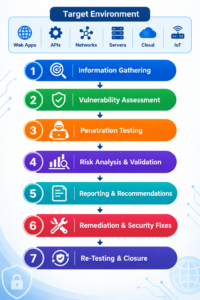
Working
Step 1: Learn Cybersecurity Fundamentals
Step 2: Information Gathering
Step 3: Vulnerability Assessment
Step 4: Penetration Testing
Step 5: Risk Analysis
Step 6: Report Writing
Step 7: Remediation & Re-Testing
Advantages
VAPT training provides numerous benefits for both individuals and organizations.
- Develops practical ethical hacking skills.
- Builds expertise in identifying security vulnerabilities.
- Enhances knowledge of web, network, API, and cloud security.
- Provides hands-on experience with industry-standard tools.
- Improves analytical and problem-solving abilities.
- Prepares learners for cybersecurity certifications.
- Increases employability in the cybersecurity domain.
- Helps organizations strengthen their security posture.
- Promotes secure coding and defensive practices.
- Enables proactive risk management.
Disadvantages
While VAPT training is highly beneficial, there are some challenges.
- Requires continuous learning to keep up with evolving threats.
- Practical labs can be time-intensive.
- Advanced topics may be challenging for beginners.
- Some commercial security tools require paid licenses.
- Ethical and legal guidelines must always be followed.
- Continuous hands-on practice is necessary to maintain skills.
Tools
The following tools are commonly used during VAPT training.
| Tool | Purpose |
| Nmap | Network discovery and port scanning |
| Burp Suite | Web application penetration testing |
| OWASP ZAP | Automated web vulnerability scanning |
| Metasploit Framework | Exploitation and penetration testing |
| Nessus | Vulnerability assessment |
| Nikto | Web server security scanning |
| SQLmap | SQL Injection testing |
| Wireshark | Network traffic analysis |
| Hydra | Password auditing |
| Gobuster | Directory and file enumeration |
| Dirsearch | Content discovery |
| FFUF | Web fuzzing |
| Postman | API security testing |
| John the Ripper | Password auditing and recovery (authorized use only) |
| Aircrack-ng | Wireless security testing |
Interview Questions
1. What is VAPT?
Answer:
VAPT stands for Vulnerability Assessment and Penetration Testing. It is a systematic approach to identifying, validating, and helping remediate security vulnerabilities in systems, applications, and networks.
2. What is the difference between Vulnerability Assessment and Penetration Testing?
Answer:
- Vulnerability Assessment identifies and prioritizes security weaknesses.
- Penetration Testing ethically exploits vulnerabilities to verify their impact.
3. What are the phases of VAPT?
Answer:
- Planning
- Information Gathering
- Vulnerability Assessment
- Exploitation
- Validation
- Reporting
- Remediation
- Re-Testing
4. Name some popular VAPT tools.
Answer:
- Nmap
- Burp Suite
- Nessus
- OWASP ZAP
- Metasploit
- SQLmap
- Wireshark
5. Why is report writing important?
Answer:
A detailed report helps organizations understand risks, prioritize remediation efforts, and improve their overall security posture.
6. What skills are required to become a VAPT professional?
Answer:
- Networking
- Linux
- Web Technologies
- Scripting (Python/Bash)
- Web Security
- API Security
- Cloud Fundamentals
- Report Writing
- Problem Solving
Conclusion
VAPT training is an excellent starting point for anyone looking to build a successful career in cybersecurity. By combining theoretical knowledge with practical experience, learners develop the skills required to identify vulnerabilities, perform ethical penetration testing, and recommend effective security improvements. As organizations continue to prioritize cybersecurity, skilled VAPT professionals remain in high demand across industries. Continuous learning, ethical practices, and hands-on experience are the foundations of long-term success in this field.
🚀 Start Your Cybersecurity Career with SecureFlow Infotech!
Become an industry-ready VAPT Professional through Secure Flow Infotech’s Practical VAPT Training Program.
What You’ll Learn
- Ethical Hacking Fundamentals
- Networking & Linux
- Web Application Security
- API Security Testing
- Mobile Application Security
- Network Penetration Testing
- OWASP Top 10
- Vulnerability Assessment
- Professional Report Writing
- Real-Time Projects & Hands-on Labs
Why Choose SecureFlow Infotech?
- ✅ Certified & Experienced Trainers
- ✅ Live Projects and Practical Labs
- ✅ Industry-Oriented Curriculum
- ✅ Placement Assistance
- ✅ Online & Offline Training
- ✅ Interview Preparation & Resume Support
- ✅ Flexible Batch Timings
📞 Contact Us:
+91 91339 19666
+91 91884 94949
Take the first step toward becoming a skilled Ethical Hacker and VAPT Professional with SecureFlow Infotech. Enroll today and secure your future in cybersecurity!