Introduction
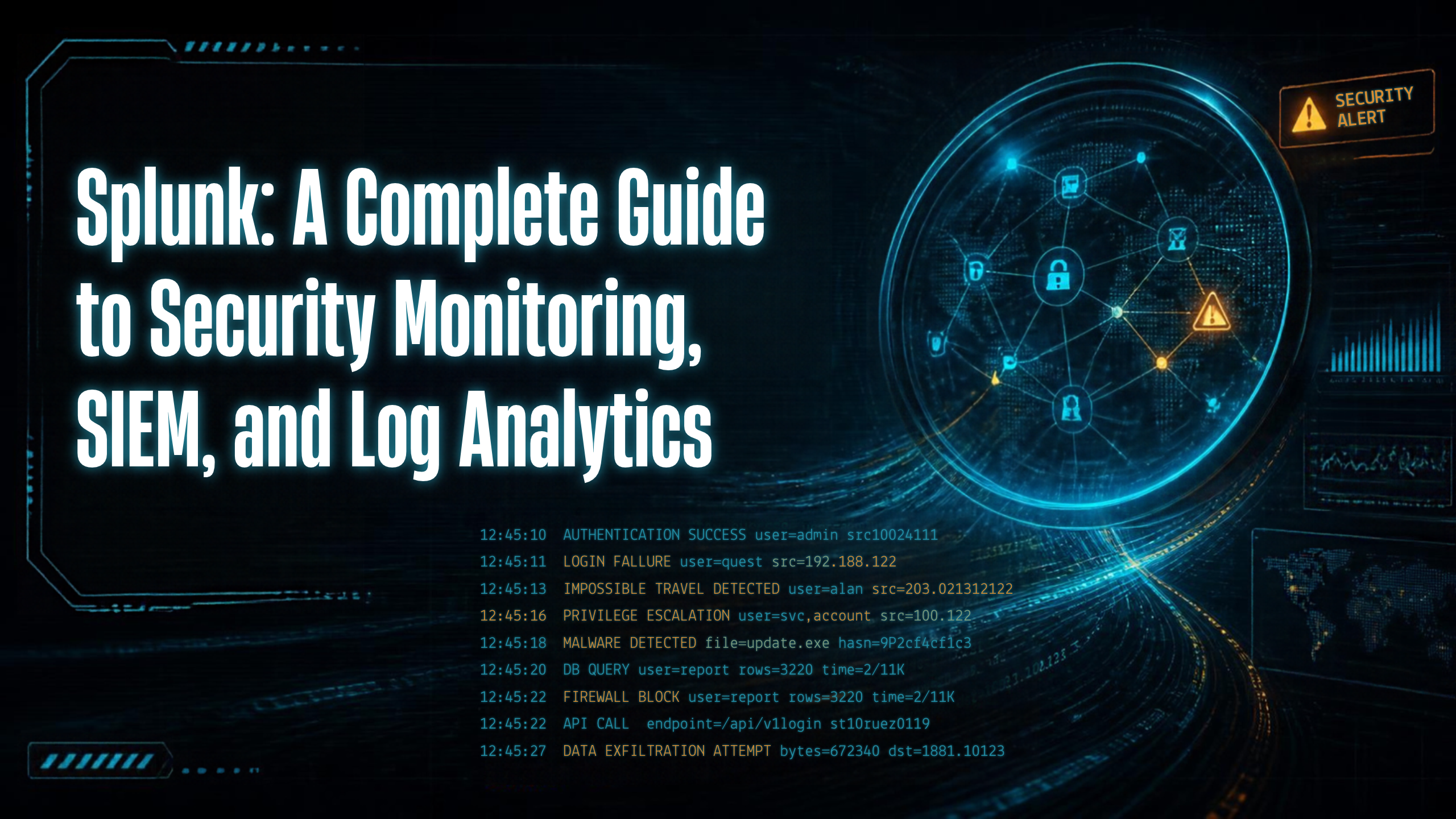
In today’s cybersecurity landscape, organizations generate massive amounts of data from servers, applications, networks, cloud platforms, endpoints, and security devices. Analyzing this huge volume of data manually is difficult and time-consuming. Security teams need a powerful platform that can collect, analyze, visualize, and detect threats from different data sources in real time.
Definition
Splunk is a data analytics and security monitoring platform that collects, indexes, searches, monitors, and analyzes machine-generated data from various sources such as servers, applications, networks, endpoints, and security devices.
Architecture
Data Sources
————————————————-
Servers | Firewalls | Applications | Cloud
Endpoints | Databases | Network Devices
————————————————-
|
v
Splunk Forwarders
|
v
Indexers
(Data Processing & Storage)
|
v
Search Heads
(Search & Visualization)
|
v
Splunk Dashboards & Alerts
|
v
SOC Analysts
Working
Step 1: Data Collection
Step 2: Data Forwarding
Step 3: Data Indexing
Step 4: Data Searching
Step 5: Event Correlation
Step 6: Alert Generation
Step 7: Investigation and Response
Advantages
Splunk provides many benefits for security and IT operations.
1. Centralized Log Management
Collects logs from multiple sources into one platform.
2. Real-Time Monitoring
Provides real-time visibility into security events.
3. Advanced Threat Detection
Helps detect:
- Malware
- Ransomware
- Insider threats
- Unauthorized access
- Data breaches
4. Powerful Search Capability
SPL allows analysts to quickly search and analyze large datasets.
5. Custom Dashboards
Users can create dashboards for:
- Security monitoring
- Compliance
- Performance analysis
6. Faster Incident Response
Helps SOC teams investigate and respond to threats quickly.
7. Integration Support
Splunk integrates with:
- EDR tools
- Firewalls
- Cloud platforms
- Threat intelligence platforms
- SOAR solutions
Disadvantages
Despite its capabilities, Splunk has some limitations.
- Expensive licensing costs.
- Requires skilled administrators.
- Complex initial configuration.
- Large data volumes require significant storage.
- SPL requires learning and practice.
- Continuous maintenance and tuning are required.
- Incorrect configurations may create false alerts.
Tools
| Tool | Purpose |
| Splunk Enterprise | Log management and data analytics |
| Splunk Enterprise Security | SIEM and threat detection |
| Splunk Cloud Platform | Cloud-based SIEM |
| Splunk SOAR | Security automation and response |
| Splunk Universal Forwarder | Data collection |
| Splunk Phantom | Security orchestration |
| Splunk Dashboard Studio | Data visualization |
| Splunk App for Microsoft Exchange | Email monitoring |
| Splunk App for AWS | Cloud monitoring |
| Splunk Add-ons | Data integration and parsing |
Interview Questions
1. What is Splunk?
Answer:
Splunk is a data analytics and SIEM platform used for collecting, monitoring, searching, and analyzing machine-generated data.
2. What is SPL?
Answer:
SPL (Search Processing Language) is Splunk’s query language used to search, analyze, and manipulate data.
3. What are the main components of Splunk architecture?
Answer:
The main components are:
- Forwarder
- Indexer
- Search Head
- Deployment Server
- Cluster Master
4. What is a Splunk Indexer?
Answer:
An Indexer processes incoming data, stores indexed events, and makes data available for searching.
5. What is a Splunk Forwarder?
Answer:
A Forwarder is a lightweight agent that collects data from systems and sends it to Splunk Indexers.
6. How is Splunk used in SOC operations?
Answer:
SOC teams use Splunk for:
- Log monitoring.
- Threat detection.
- Alert investigation.
- Incident response.
- Threat hunting.
7. What is Splunk Enterprise Security?
Answer:
Splunk Enterprise Security is a SIEM solution that provides security monitoring, threat detection, incident investigation, and compliance capabilities.
Conclusion
Splunk is one of the most powerful platforms for log management, security monitoring, threat detection, and incident response. Its ability to collect data from multiple sources, analyze security events in real time, and provide actionable insights makes it an essential tool for modern Security Operations Centers.
By mastering Splunk, cybersecurity professionals can improve their skills in SIEM operations, threat detection, incident investigation, and security analytics. As organizations continue to face increasing cyber threats, Splunk expertise remains highly valuable in the cybersecurity industry.
🚀 Master Splunk & SIEM with Secure Flow Infotech
Build your cybersecurity career with Secure Flow Infotech’s SOC & SIEM Training Program and gain hands-on experience with Splunk, threat detection, and real-time security monitoring.
What You’ll Learn
- Splunk Fundamentals
- Splunk Architecture
- SPL Queries
- Log Collection & Analysis
- SIEM Operations
- Security Monitoring
- Threat Detection
- Incident Investigation
- Dashboard Creation
- Alert Management
- Real-Time SOC Labs
Why Choose Secure Flow Infotech?
✅ Certified & Experienced Trainers
✅ Hands-on Splunk Practice
✅ Real-Time SOC Environment
✅ Industry-Based Curriculum
✅ Interview Preparation
✅ Placement Assistance
✅ Online & Offline Training
📞 Contact Us:
+91 91339 19666
+91 91884 94949
Join Secure Flow Infotech today and become an industry-ready SOC Analyst with practical Splunk and SIEM skills.