Introduction
In today’s fast-paced software development environment, organizations must deliver high-quality applications quickly and reliably. Traditional software release processes often involve manual builds, testing, and deployments, leading to delays, human errors, and inconsistent releases.
Definition
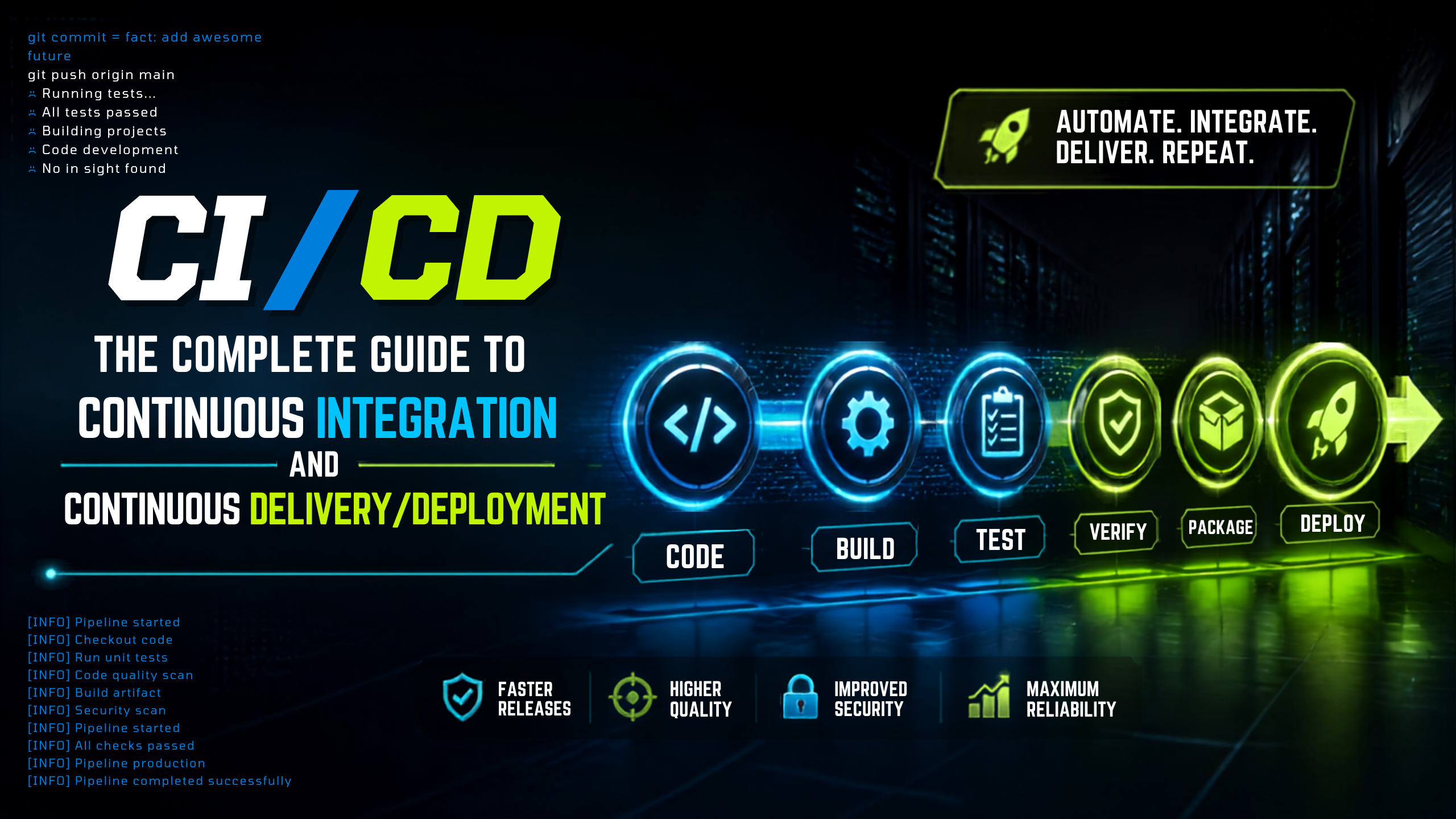
CI/CD (Continuous Integration and Continuous Delivery/Deployment) is a DevOps methodology that automates the process of building, testing, integrating, and deploying software applications.
Architecture
+———————-+
| Developer |
| Code Commit |
+———-+———–+
|
Git Repository
|
Continuous Integration
|
———————————
| | | |
Build Unit Test Code Scan Package
|
Artifact Repository
|
Continuous Delivery
|
————————————
| | |
Staging Integration Test Approval
|
Continuous Deployment
|
Production Environment
|
Monitoring & Feedback
Working
Step 1: Developer Writes Code
Step 2: Commit Code
Step 3: Trigger CI Pipeline
Step 4: Build Application
Step 5: Run Automated Tests
Step 6: Store Artifact
Step 7: Deploy to Staging
Step 8: Deploy to Production
Step 9: Monitor Application
Advantages
1. Faster Software Delivery
Automates repetitive tasks, enabling quicker releases.
2. Improved Code Quality
Automated testing detects issues early in the development cycle.
3. Reduced Human Errors
Automation minimizes manual deployment mistakes.
4. Faster Bug Detection
Frequent integration identifies problems sooner.
5. Consistent Deployments
Ensures identical deployment processes across environments.
6. Better Collaboration
Improves communication between development, operations, and QA teams.
7. Easy Rollbacks
Makes it easier to revert to previous stable versions if issues occur.
8. Higher Customer Satisfaction
Frequent, reliable releases provide users with new features and fixes more quickly.
Disadvantages
1. Initial Setup Complexity
Designing and implementing a CI/CD pipeline requires planning and expertise.
2. Tool Integration Challenges
Integrating multiple tools can increase complexity.
3. Infrastructure Costs
Running build servers, artifact repositories, and test environments may increase operational costs.
4. Pipeline Maintenance
Pipelines require regular updates to support changing technologies and workflows.
5. Security Risks
Poorly secured pipelines or exposed credentials can create vulnerabilities.
Tools
| Tool | Purpose |
| Git | Version control |
| GitHub | Source code hosting |
| GitLab CI/CD | Integrated CI/CD platform |
| Jenkins | Automation server |
| Azure DevOps | CI/CD pipelines |
| GitHub Actions | Workflow automation |
| Bitbucket Pipelines | CI/CD automation |
| Docker | Containerization |
| Kubernetes | Container orchestration |
| Terraform | Infrastructure as Code |
| Ansible | Configuration management |
| SonarQube | Code quality analysis |
| Nexus Repository | Artifact management |
| JFrog Artifactory | Artifact repository |
| Prometheus | Monitoring |
| Grafana | Visualization and dashboards |
Interview Questions
Basic
1. What is CI/CD?
CI/CD is a DevOps practice that automates software integration, testing, and deployment to deliver applications faster and more reliably.
2. What is Continuous Integration?
Continuous Integration is the process of frequently merging code changes into a shared repository and validating them through automated builds and tests.
3. What is Continuous Delivery?
Continuous Delivery prepares code for deployment after successful testing, with production release typically requiring manual approval.
4. What is Continuous Deployment?
Continuous Deployment automatically deploys every successful code change to production without manual intervention.
5. Why is CI/CD important?
It improves software quality, accelerates releases, reduces manual effort, and supports consistent deployments.
Conclusion
CI/CD has become an essential practice in modern software development by enabling faster, more reliable, and automated application delivery. Through continuous integration, automated testing, and streamlined deployment, organizations can reduce errors, improve software quality, and respond more quickly to changing business needs.
Combined with technologies such as Git, Docker, Kubernetes, Terraform, and cloud platforms, CI/CD empowers DevOps teams to build efficient, scalable, and resilient software delivery pipelines.
CTA
🚀 Master CI/CD with Secure Flow InfoTech Pvt. Ltd.
Accelerate your DevOps career with hands-on CI/CD Training from Secure Flow InfoTech Pvt. Ltd.
What You’ll Learn
- CI/CD Fundamentals
- Git & Version Control
- Jenkins Pipeline Development
- GitHub Actions & GitLab CI/CD
- Azure DevOps Pipelines
- Docker Integration
- Kubernetes Deployment
- Terraform & Infrastructure as Code
- Automated Testing
- Artifact Management
- Monitoring & Logging
- Real-Time DevOps Projects
- Interview Preparation
Why Choose Secure Flow InfoTech Pvt. Ltd.?
- Certified Industry Trainers
- Hands-on Real-Time Projects
- Online & Offline Training
- Placement Assistance
- Resume Building and Mock Interviews
- Flexible Batch Timings
- Industry-Oriented Curriculum
Courses Offered
- DevOps (AWS, Azure & GCP)
- Docker & Kubernetes
- CI/CD & Jenkins
- Terraform & Infrastructure as Code
- Cybersecurity (VAPT)
- Cybersecurity (SOC & SIEM)
- Azure Data Engineering
📞 Contact: +91 91339 19666 | +91 91884 94949
Automate, Build, Test, and Deploy with Confidence—Join Secure Flow InfoTech Pvt. Ltd. and become a job-ready DevOps professional!