Introduction
In today’s data-driven world, organizations generate massive amounts of structured, semi-structured, and unstructured data every second. Processing, analyzing, and deriving insights from this data requires a powerful, scalable, and cloud-native platform. This is where Databricks comes into the picture.
Definition
Databricks is a cloud-based unified analytics platform that combines data engineering, data science, machine learning, and business intelligence into a single collaborative environment.
It was founded by the creators of Apache Spark and provides optimized Spark clusters, collaborative notebooks, Delta Lake, MLflow integration, and advanced data governance capabilities.
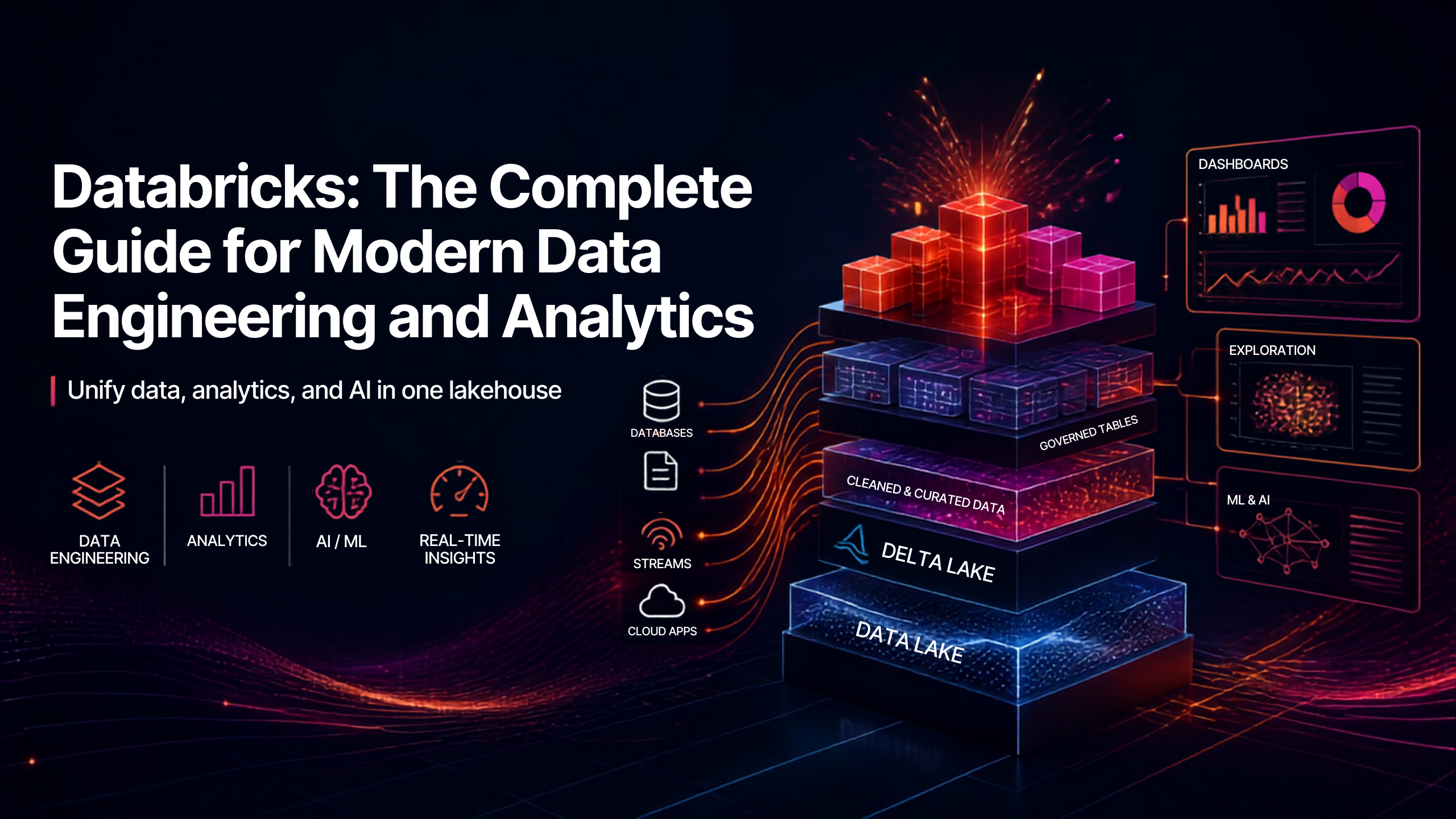
Architecture
Data Sources
—————————-
Databases | APIs | Files
IoT | ERP | CRM | Logs
—————————-
Data Ingestion
Azure Data Factory
Kafka | Event Hub
↓
Delta Lake Storage
Bronze → Silver → Gold Layers
↓
Databricks Workspace
————————————
Notebooks
Spark Clusters
SQL Warehouse
MLflow
Delta Engine
Workflows
———————————-
↓
Business Intelligence
Power BI | Tableau | Excel
↓
Dashboards & Decision Making
Working
Step 1: Data Ingestion
Step 2: Data Storage
Step 3: Data Processing
Step 4: Data Transformation
Step 5: Analytics
Step 6: Machine Learning
Step 7: Deployment
Advantages
1. Unified Platform
One platform for Data Engineering, Analytics, AI, and Machine Learning.
2. High Performance
Optimized Apache Spark engine provides faster execution.
3. Easy Collaboration
Multiple users can work together using shared notebooks.
4. Scalable
Automatically scales clusters based on workload.
5. Delta Lake Integration
Provides reliable and efficient data lakes with ACID transactions.
6. Multi-cloud Support
Available on:
- Microsoft Azure
- AWS
- Google Cloud Platform
7. Built-in Machine Learning
Supports end-to-end ML lifecycle with MLflow.
8. Cost Optimization
Auto-scaling and auto-termination reduce cloud costs.
Disadvantages
1. Learning Curve
Beginners may need time to understand Spark and distributed computing.
2. Cloud Dependency
Primarily designed for cloud environments.
3. Cost Management
Improper cluster configuration can increase cloud expenses.
4. Apache Spark Knowledge Required
Understanding Spark improves efficiency and troubleshooting.
5. Vendor Lock-in
Heavy use of proprietary Databricks features may make migration more challenging.
Tools
| Tool | Purpose |
| Apache Spark | Distributed Data Processing |
| Delta Lake | Reliable Data Lake Storage |
| MLflow | Machine Learning Lifecycle Management |
| Apache Kafka | Real-time Data Streaming |
| Azure Data Factory | Data Orchestration |
| Azure Data Lake Storage (ADLS) | Cloud Storage |
| Power BI | Data Visualization |
| Tableau | Business Intelligence |
| GitHub | Version Control |
| Azure DevOps | CI/CD |
| Python | Data Engineering |
| PySpark | Spark Programming |
| SQL | Analytics |
| Scala | Spark Development |
| Jupyter Notebook | Interactive Development |
Interview Questions
1. What are Databricks?
Answer: Databricks is a cloud-based unified analytics platform built on Apache Spark for data engineering, analytics, and machine learning.
2. What is Delta Lake?
Answer: Delta Lake is a storage layer that provides ACID transactions, schema enforcement, time travel, and improved reliability for data lakes.
3. What is the Medallion Architecture?
Answer: A layered data design pattern with Bronze (raw), Silver (cleaned), and Gold (business-ready) datasets.
4. What languages does Databricks support?
Answer:
- Python
- PySpark
- SQL
- Scala
- Java
- R
5. What is Unity Catalog?
Answer: Unity Catalog is Databricks’ centralized governance solution for managing data access, metadata, and lineage across workspaces.
6. What is an Auto Loader?
Answer: Auto Loader is a feature that incrementally ingests new files from cloud storage efficiently and reliably.
7. What is MLflow?
Answer: MLflow is an open-source platform integrated with Databricks for managing machine learning experiments, models, and deployments.
8. How does Databricks improve Apache Spark?
Answer: Databricks provides optimized Spark runtimes, managed clusters, collaborative notebooks, automated scaling, security, and workflow orchestration.
9. What is the difference between a Job Cluster and an All-Purpose Cluster?
Answer: Job Clusters are created for scheduled jobs and terminate after completion, while All-Purpose Clusters are interactive clusters used for development and collaboration.
10. Why is Databricks popular in Azure Data Engineering?
Answer: Databricks integrates seamlessly with Azure services such as Azure Data Factory, Azure Data Lake Storage, Microsoft Fabric, Power BI, and Azure Synapse Analytics, making it a preferred platform for building scalable data engineering solutions.
Conclusion
Databricks has transformed modern data engineering by providing a unified platform for data ingestion, processing, analytics, and machine learning. Its deep integration with Apache Spark, Delta Lake, and major cloud providers enables organizations to build reliable, scalable, and high-performance data pipelines. With features such as collaborative notebooks, automated workflows, robust governance, and support for AI workloads, Databricks has become a leading choice for enterprises embracing cloud-native data platforms.
For aspiring data professionals, mastering Databricks alongside SQL, PySpark, Azure Data Factory, Azure Data Lake Storage, and cloud technologies can significantly enhance career opportunities in Azure Data Engineering and big data.
CTA
Become an Azure Data Engineering Expert with SecureFlow Infotech
Ready to build a successful career in Azure Data Engineering? Join SecureFlow Infotech and gain practical experience with industry-leading tools, including Databricks, SQL, PySpark, Azure Data Factory, Azure Data Lake Storage, Microsoft Fabric, and Azure Synapse Analytics.
Our Training Includes:
- Industry-focused curriculum
- Hands-on projects and real-world case studies
- Training by certified professionals
- Interview preparation and mock interviews
- Resume building assistance
- Placement support
- Online and Offline learning options
Start your Azure Data Engineering journey today with SecureFlow Infotech and develop the skills employers are looking for in the modern data ecosystem.