Introduction:
As organizations adopt cloud computing, remote work, and interconnected digital systems, the volume of security events generated every day has increased dramatically. Firewalls, servers, applications, endpoints, cloud platforms, and network devices continuously generate logs that contain valuable security information. Monitoring these logs manually is nearly impossible.
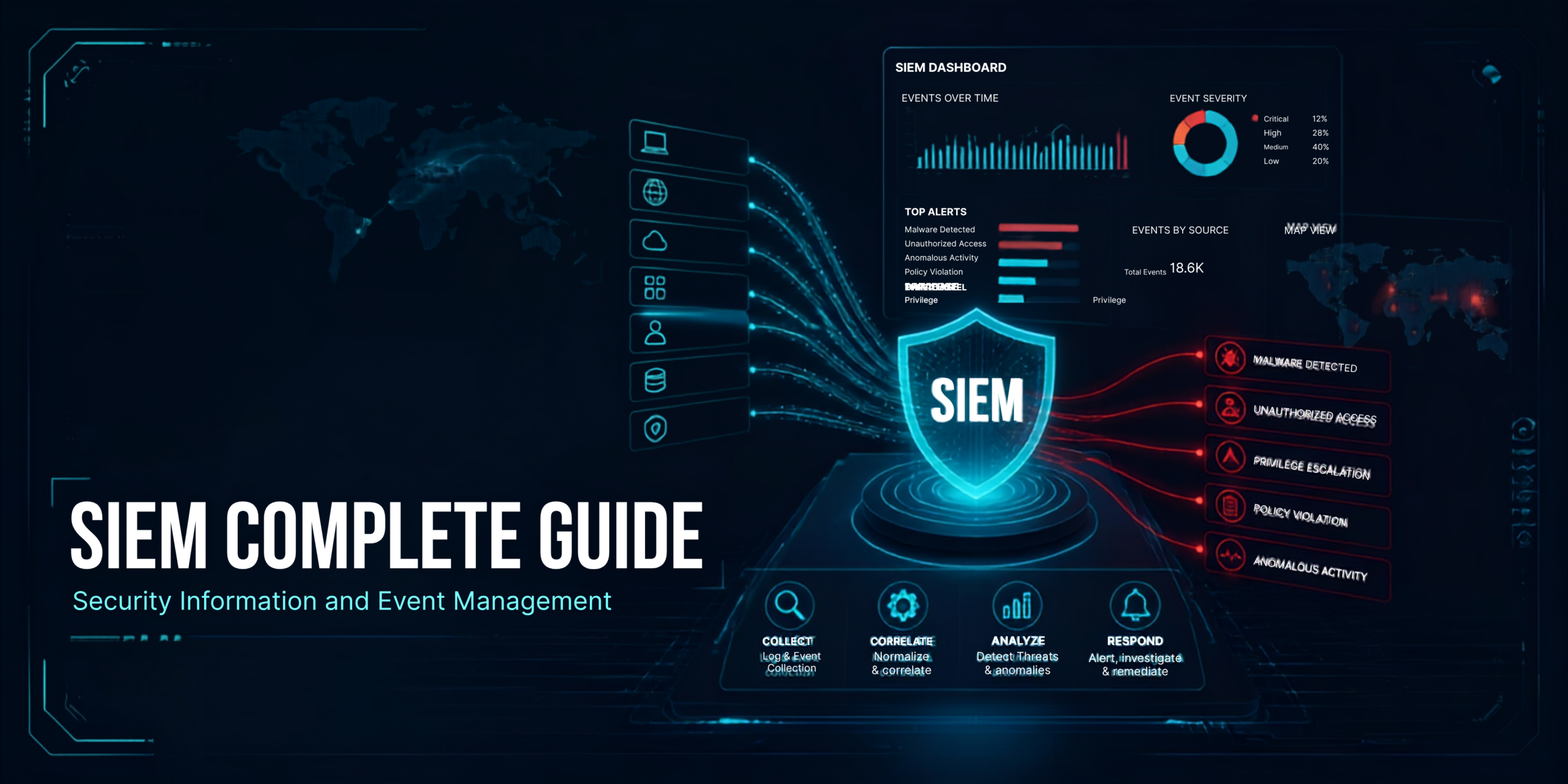
This is where Security Information and Event Management (SIEM) comes into play. SIEM is a centralized security solution that collects, analyzes, correlates, and monitors logs from multiple sources to detect cyber threats in real time. It helps security teams identify suspicious activities, investigate incidents, and respond quickly to minimize damage.
Definition:
Security Information and Event Management (SIEM) is a cybersecurity solution that collects, aggregates, normalizes, correlates, and analyzes security logs from various systems and devices to identify suspicious activities and security incidents in real time.
Architecture:
Security Devices & Systems
———————————————————
Firewalls | Servers | Endpoints | Cloud | Applications
IDS/IPS | Databases | VPN | Email | Active Directory
———————————————————
|
Log Collection Agents
|
Log Aggregation & Normalization
|
Correlation Engine & Analytics
|
+————-+————–+
| |
| |
Threat Intelligence Detection Rules
| |
+————-+————–+
|
Alert Generation & SIEM Dashboard
|
SOC Analyst Investigation
|
Incident Response & Remediation
Working:
Step 1: Log Collection
Step 2: Log Normalization
Step 3: Correlation
Step 4: Threat Detection
Step 5: Alert Generation
Step 6: Investigation
Step 7: Incident Response
Step 8: Reporting .
Advantages:
Implementing a SIEM solution provides numerous benefits.
- Centralized log management.
- Real-time threat detection.
- Faster incident response.
- Improved visibility across the IT environment.
- Supports regulatory compliance (ISO 27001, PCI-DSS, HIPAA, GDPR).
- Detects insider threats.
- Simplifies forensic investigations.
- Integrates with threat intelligence feeds.
- Reduces manual monitoring efforts.
- Enhances SOC efficiency.
Disadvantages:
Although SIEM is powerful, it also has certain challenges.
- High implementation and licensing costs.
- Complex deployment and configuration.
- Large storage requirements for logs.
- Requires skilled SOC analysts.
- False positives can overwhelm security teams.
- Continuous tuning of correlation rules is necessary.
- Performance may be affected in very large environments if not properly optimized.
Tools:
| Tool | Purpose |
| Microsoft Sentinel | Cloud-native SIEM and SOAR platform |
| Splunk Enterprise Security | Log management, analytics, and threat detection |
| IBM QRadar | Enterprise SIEM and security analytics |
| ArcSight ESM | Security event monitoring and correlation |
| Elastic Security | SIEM and endpoint security built on the Elastic Stack |
| Wazuh | Open-source SIEM and XDR platform |
| LogRhythm | SIEM, UEBA, and threat detection |
| Google Security Operations | Cloud-native SIEM and threat analytics |
| Exabeam | User and Entity Behavior Analytics (UEBA) with SIEM |
| Sumo Logic Cloud SIEM | Cloud-native security analytics and monitoring |
Interview Questions:
1. What is SIEM?
Answer:
SIEM (Security Information and Event Management) is a centralized security solution that collects, analyzes, correlates, and monitors logs from multiple systems to detect and respond to security threats.
2. What is the difference between SIM and SEM?
Answer:
- SIM (Security Information Management): Focuses on log collection, storage, reporting, and compliance.
- SEM (Security Event Management): Focuses on real-time event monitoring, correlation, and alerting.
3. Why is SIEM important?
Answer:
SIEM provides centralized visibility, enables rapid threat detection, improves incident response, and helps organizations meet compliance requirements.
4. What is log normalization?
Answer:
Log normalization is the process of converting logs from different devices and applications into a common format for consistent analysis and correlation.
5. What are correlation rules?
Answer:
Correlation rules analyze related events from multiple sources to identify suspicious patterns that may indicate a security incident.
6. How does SIEM help a SOC?
Answer:
SIEM provides SOC analysts with centralized log visibility, automated alerting, event correlation, dashboards, and investigation capabilities, enabling faster detection and response to cyber threats.
Conclusion:
SIEM is a cornerstone of modern cybersecurity operations, enabling organizations to monitor, detect, investigate, and respond to threats from a single centralized platform. By collecting and correlating logs from across the IT environment, SIEM provides the visibility needed to identify attacks early, reduce response times, and support compliance requirements. When combined with skilled SOC analysts, threat intelligence, and automated response capabilities, SIEM significantly strengthens an organization’s overall security posture.
CTA
🚀 Master SIEM with SecureFlow Infotech
Build a successful career in cybersecurity with SecureFlow Infotech’s SOC & SIEM Training Program. Gain hands-on experience with enterprise-grade SIEM tools and learn how to monitor, detect, and respond to real-world cyber threats.
What You’ll Learn
- SIEM Fundamentals
- Log Collection & Analysis
- Event Correlation
- Threat Detection
- Incident Response
- Microsoft Sentinel
- Splunk Enterprise Security
- IBM QRadar
- MITRE ATT&CK Framework
- SOC Operations
- Real-Time Security Monitoring
- Hands-on Labs & Projects
Why Choose SecureFlow Infotech?
-
- ✅ Certified & Experienced Trainers
- ✅ Practical Hands-on Training
- ✅ Real-Time SOC Lab Environment
- ✅ Industry-Oriented Curriculum
- ✅ Placement Assistance
- ✅ Interview Preparation
- ✅ Online & Offline Training
- ✅ Flexible Batch Timings
📞 Contact Us:
+91 91339 19666
+91 91884 94949
Take the next step toward becoming a skilled SOC Analyst or SIEM Engineer with SecureFlow Infotech. Enroll today and gain the practical expertise needed to secure modern organizations against evolving cyber threats.