Introduction
In today’s digital world, cyberattacks such as ransomware, phishing, malware infections, data breaches, and insider threats are increasing rapidly. No organization can guarantee complete protection from cyber incidents, making it essential to have a well-defined process to detect, analyze, contain, and recover from security threats.
Definition
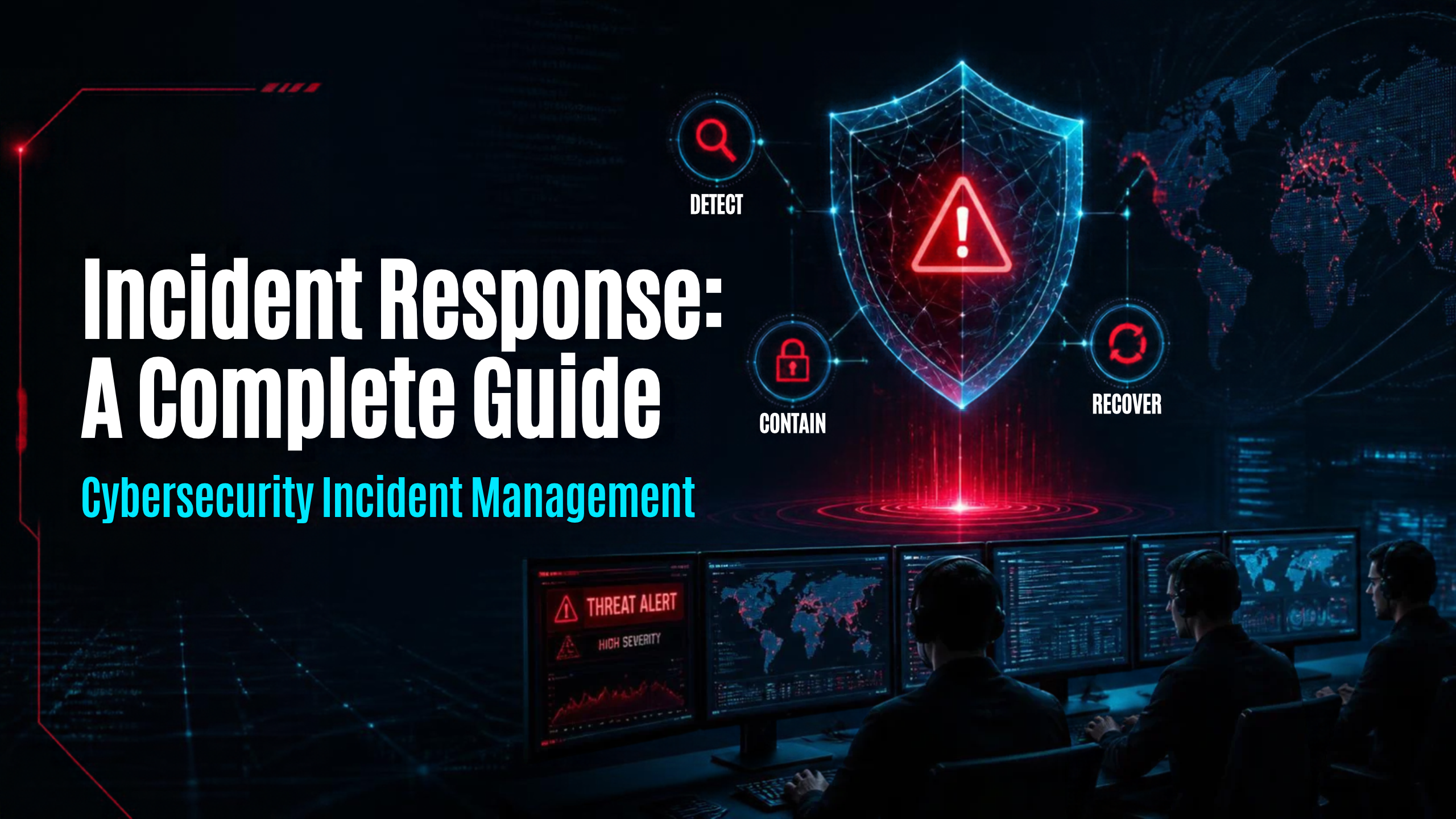
Incident Response (IR) is the process of preparing for, detecting, analyzing, containing, eliminating, and recovering from cybersecurity incidents.
A cybersecurity incident can include:
- Malware infection
- Ransomware attack
- Phishing attack
- Data breach
- Unauthorized access
- Insider threat
- Account compromise
- Network intrusion
- Denial-of-Service (DoS) attack
The main goal of Incident Response is to:
- Minimize business impact.
- Reduce attacker presence.
- Recover affected systems.
- Preserve evidence.
- Prevent future incidents.
Architecture
Security Events
————————————————-
SIEM | EDR | Firewall | IDS/IPS | Cloud Logs
Email Security | Network Monitoring
——————————————
|
v
Alert Detection
|
v
SOC Monitoring Team
|
v
Incident Response Process
+————-+————-+———-+
| | | |
Detection Analysis Containment Recovery
|
v
Lessons Learned & Improvement
Working
- Preparation
- Identification / Detection
- Analysis
- Containment
- Eradication
- Recovery
- Lessons Learned
Advantages
Incident Response provides several benefits to organizations.
- Reduces the impact of cyberattacks.
- Enables faster threat detection.
- Minimizes downtime.
- Protects sensitive information.
- Improves recovery speed.
- Supports compliance requirements.
- Enhances security awareness.
- Provides forensic evidence.
- Improves cybersecurity maturity.
- Helps prevent repeated attacks.
Disadvantages
Incident Response also has some challenges.
- Requires skilled cybersecurity professionals.
- Can be expensive to implement.
- Requires continuous training.
- Complex incidents may take significant time to resolve.
- Large amounts of forensic data require analysis.
- Poor planning can increase recovery time.
- Security teams may experience high pressure during major incidents.
Tools
| Tool | Purpose |
| Splunk Enterprise Security | SIEM and incident investigation |
| Microsoft Sentinel | Cloud SIEM and automated response |
| IBM QRadar | Security event monitoring |
| CrowdStrike Falcon | Endpoint detection and response |
| Microsoft Defender for Endpoint | Endpoint investigation |
| Wazuh | Open-source SIEM/XDR |
| TheHive | Incident response case management |
| Cortex XSOAR | Security automation and orchestration |
| Wireshark | Network packet analysis |
| Volatility | Memory forensics |
| Autopsy | Digital forensic investigation |
| VirusTotal | Malware and IOC analysis |
| MISP | Threat intelligence sharing |
Interview Questions
1. What is Incident Response?
Answer:
Incident Response is a structured process used to detect, analyze, contain, eradicate, and recover from cybersecurity incidents.
2. What are the phases of Incident Response?
Answer:
The main phases are:
- Preparation
- Identification
- Analysis
- Containment
- Eradication
- Recovery
- Lessons Learned
3. What is the difference between Incident Detection and Incident Response?
Answer:
- Incident Detection: Identifies suspicious activities.
- Incident Response: Handles and resolves security incidents.
4. What is containment in Incident Response?
Answer:
Containment is the process of limiting the spread and impact of a security incident.
5. What is the role of a SOC Analyst during an incident?
Answer:
A SOC Analyst:
- Monitors alerts.
- Investigates threats.
- Performs initial analysis.
- Escalates incidents.
- Supports containment activities.
6. What is a Root Cause Analysis?
Answer:
Root Cause Analysis identifies the main reason behind a security incident to prevent similar attacks in the future.
Conclusion
Incident Response is a critical component of modern cybersecurity that helps organizations prepare for, detect, analyze, and recover from cyber threats. With the increasing frequency of ransomware, phishing attacks, and data breaches, having a strong Incident Response strategy is essential for protecting business operations and sensitive information.
By combining skilled security professionals, advanced tools, threat intelligence, and effective processes, organizations can minimize the impact of cyber incidents and improve their overall security resilience.
🚀 Build Your Cybersecurity Career with Secure Flow Infotech
Join Secure Flow Infotech’s SOC, SIEM & Incident Response Training Program and gain practical skills to detect, investigate, and respond to real-world cyber threats.
What You’ll Learn
- Incident Response Lifecycle
- SOC Operations
- SIEM Monitoring
- Log Analysis
- Threat Detection
- Malware Investigation
- Digital Forensics Basics
- MITRE ATT&CK Framework
- Threat Hunting
- Real-Time Incident Response Labs
Why Choose SecureFlow Infotech?
✅ Certified & Experienced Trainers
✅ Hands-on Security Labs
✅ Real-Time Attack Scenarios
✅ Industry-Based Curriculum
✅ Placement Assistance
✅ Interview Preparation
✅ Online & Offline Training
📞 Contact Us:
+91 91339 19666
+91 91884 94949
Start your journey with Secure Flow Infotech and become an industry-ready Cybersecurity Professional specializing in SOC Operations and Incident Response.