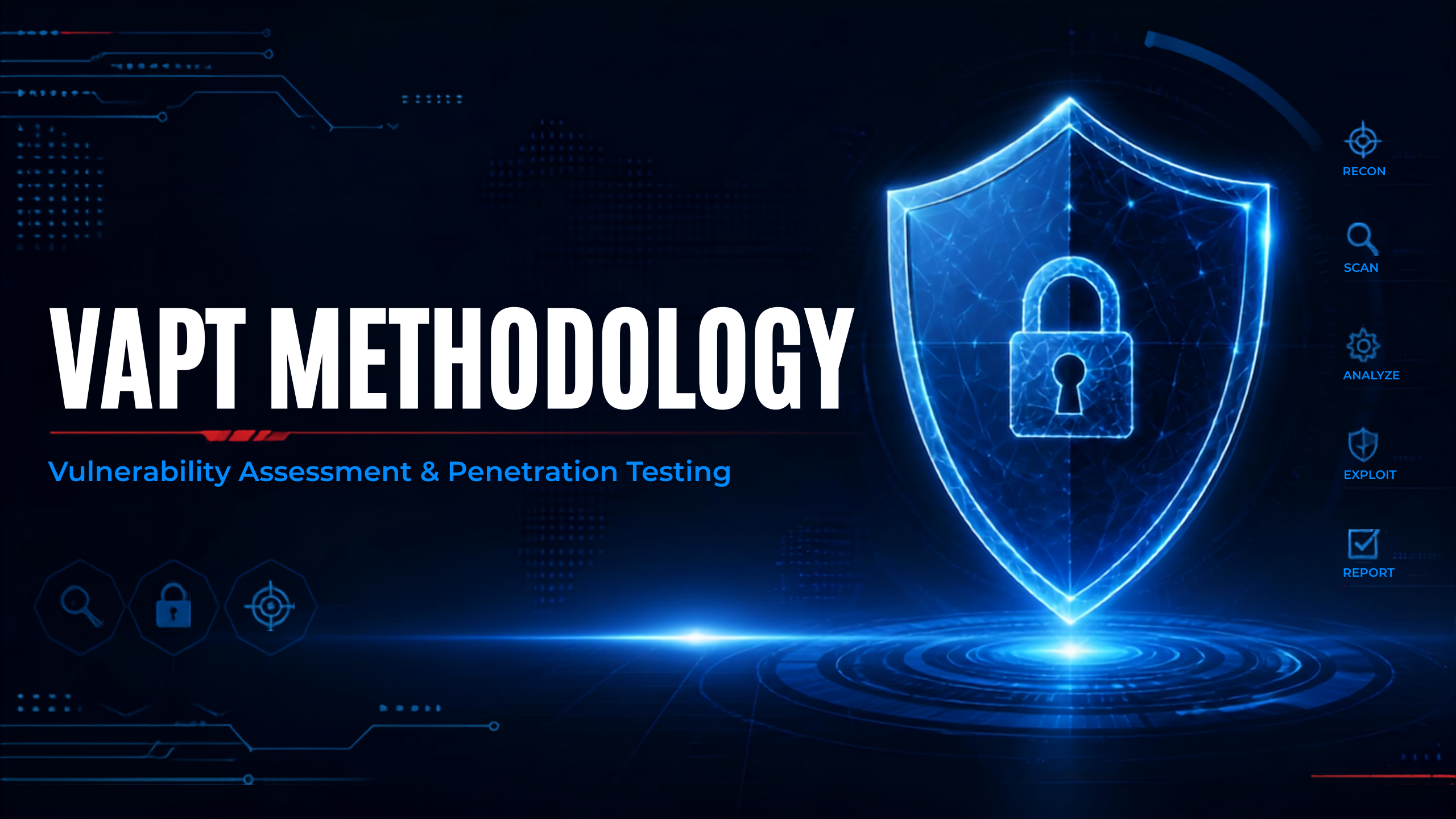
VAPT Methodology :
Introduction:
As cyber threats continue to evolve, organizations must proactively identify and eliminate security weaknesses before attackers can exploit them. One of the most effective approaches to achieving this is Vulnerability Assessment and Penetration Testing (VAPT). A well-defined VAPT methodology helps organizations assess their security posture, discover vulnerabilities, and validate whether those vulnerabilities can be exploited.
Whether you’re a cybersecurity professional, business owner, or aspiring ethical hacker, understanding the VAPT methodology is essential for protecting applications, networks, cloud infrastructure, and sensitive data.
Definition
Vulnerability Assessment and Penetration Testing (VAPT) Methodology is a structured process used to identify, analyze, prioritize, and validate security vulnerabilities within an organization’s IT environment.
It combines two key activities:
- Vulnerability Assessment (VA): Identifies and categorizes security weaknesses.
- Penetration Testing (PT): Simulates real-world cyberattacks to determine whether vulnerabilities can be exploited.
Architecture:
Information Gathering
Scope Definition
Vulnerability Assessment
Risk Analysis
Penetration Testing
Privilege Escalation
Post Exploitation Analysis
Reporting
Remediation
Retesting
Working
A standard VAPT methodology consists of the following phases:
Phase 1: Planning & Scope Definition
The testing team identifies:
- Assets to be tested
- Testing objectives
- Timeframe
- Rules of engagement
- Authorization
Phase 2: Information Gathering (Reconnaissance)
Collect publicly available and internal information about the target.
Examples include:
- Domain information
- IP addresses
- DNS records
- Email addresses
- Technology stack
- Open ports
Objective:
Understand the attack surface.
Phase 3: Vulnerability Assessment
Automated tools scan systems to identify:
- Missing patches
- Weak passwords
- Misconfigurations
- Outdated software
- Known CVEs
The identified vulnerabilities are categorized based on severity.
Phase 4: Risk Analysis
Security experts evaluate:
- Exploitability
- Business impact
- Likelihood
- Risk level
Severity is commonly classified as:
- Critical
- High
- Medium
- Low
- Informational
Phase 5: Penetration Testing
Ethical hackers attempt to exploit vulnerabilities.
Common attack techniques include:
- SQL Injection
- Cross-Site Scripting (XSS)
- Broken Authentication
- Remote Code Execution
- Privilege Escalation
- File Upload Vulnerabilities
Phase 6: Post Exploitation
After successful exploitation, testers evaluate:
-
- Data access
- Privilege escalation
- Lateral movement
- Persistence
- Business impact
Phase 7: Reporting
A detailed report includes:
- Executive Summary
- Technical Findings
- Screenshots
- Risk Ratings
- Proof of Concept
- CVSS Score
- Recommended Fixes
Phase 8: Remediation
Developers and administrators fix identified issues by:
- Updating software
- Applying patches
- Hardening configurations
- Fixing insecure code
- Strengthening authentication
Phase 9: Retesting
After remediation, testers verify that:
- Vulnerabilities have been fixed
- No new security issues exist
- Systems remain secure
Advantages
1. Identifies Security Weaknesses
Finds vulnerabilities before attackers exploit them.
2. Reduces Business Risk
Prevents costly cyberattacks and data breaches.
3. Regulatory Compliance
Supports compliance with standards like:
- ISO 27001
- PCI DSS
- HIPAA
- GDPR
- SOC 2
4. Improves Security Posture
Enhances the overall resilience of systems.
5. Protects Customer Data
Safeguards sensitive business and user information.
6. Supports Secure Development
Helps developers fix security flaws early in the software lifecycle.
7. Validates Existing Security Controls
Tests the effectiveness of firewalls, WAFs, IDS/IPS, and endpoint protection.
Disadvantages
Time-Consuming
Comprehensive testing may take several days or weeks.
Skilled Professionals Required
Effective penetration testing requires experienced ethical hackers.
Operational Risks
Improper testing may affect production systems if not carefully managed.
Cost
Professional VAPT engagements can be expensive for small businesses.
Snapshot Assessment
VAPT reflects the security posture at the time of testing and should be repeated periodically.
Tools
Vulnerability Assessment
- Nessus
- OpenVAS (Greenbone)
- Qualys VMDR
- Rapid7 InsightVM
- Nexpose
Penetration Testing
- Metasploit Framework
- Burp Suite
- OWASP ZAP
- Nmap
- Nikto
- SQLmap
- Hydra
- John the Ripper
- Wireshark
- Aircrack-ng
Reconnaissance
- WHOIS
- theHarvester
- Maltego
- Shodan
- Amass
- Subfinder
Interview Questions
1. What is VAPT?
Answer: VAPT is the combination of Vulnerability Assessment and Penetration Testing used to identify and validate security vulnerabilities.
2. What is the difference between Vulnerability Assessment and Penetration Testing?
Answer:
- Vulnerability Assessment identifies weaknesses.
- Penetration Testing actively exploits vulnerabilities to assess their impact.
3. What are the phases of the VAPT methodology?
Answer:
- Planning
- Information Gathering
- Vulnerability Assessment
- Risk Analysis
- Penetration Testing
- Post Exploitation
- Reporting
- Remediation
- Retesting
4. What is CVSS?
Answer: Common Vulnerability Scoring System (CVSS) is a standardized framework used to measure the severity of security vulnerabilities.
5. Why is reporting important in VAPT?
Answer: Reporting documents vulnerabilities, their business impact, proof of concept, and remediation recommendations, helping organizations prioritize fixes.
6. Which tools are commonly used in VAPT?
Answer: Nessus, Burp Suite, Metasploit, Nmap, OpenVAS, SQLmap, Wireshark, and OWASP ZAP.
Conclusion
A structured VAPT methodology is a cornerstone of modern cybersecurity. By following a systematic process—from planning and reconnaissance to vulnerability assessment, penetration testing, reporting, remediation, and retesting—organizations can proactively identify weaknesses and strengthen their defenses against cyber threats. Regular VAPT not only reduces the risk of attacks but also supports regulatory compliance, protects sensitive data, and builds trust with customers and stakeholders.
CTA
Secure Your Business with Professional VAPT Services
Don’t wait for cybercriminals to discover vulnerabilities in your systems. Proactively secure your applications, networks, APIs, and cloud infrastructure with expert Vulnerability Assessment and Penetration Testing (VAPT).
SecureFlow Infotech offers:
- ✅ Comprehensive VAPT Services
- ✅ Web, Mobile, API & Network Security Testing
- ✅ Detailed Reports with Remediation Guidance
- ✅ Industry-Experienced Cybersecurity Experts
- ✅ Hands-on Cybersecurity Training & Placement Support
📞 Call Us: +91 91339 19666 | +91 91884 94949
Protect your digital assets today—partner with SecureFlow Infotech for trusted cybersecurity solutions.