Introduction
Web applications have become an essential part of modern businesses, enabling online banking, e-commerce, healthcare, education, and enterprise services. However, as organizations increasingly rely on web applications, they also become attractive targets for cybercriminals. Vulnerabilities such as SQL Injection, Cross-Site Scripting (XSS), Broken Authentication, and Server-Side Request Forgery (SSRF) can lead to data breaches, financial losses, and reputational damage.
Web Application Penetration Testing (Web App Pentesting) is a proactive security assessment that simulates real-world cyberattacks to identify and exploit vulnerabilities before malicious attackers can. It helps organizations strengthen their web application security, meet compliance requirements, and protect sensitive user data.
Definition
Web Application Penetration Testing is a controlled and authorized security testing process in which ethical hackers assess a web application’s security by attempting to identify, exploit, and validate vulnerabilities.
Unlike automated vulnerability scanning, penetration testing combines manual techniques with automated tools to uncover security flaws, business logic issues, and misconfigurations that could be exploited by attackers.
Architecture:
User
│
Web Browser / Mobile App
│
Web Server (Apache/Nginx/IIS)
┌───────┴────────┐
Application Serve Authentication
└──────┬───────┘
Database Server
│
APIs / Third-Party Services
│
Cloud Infrastructure / Storage
Working
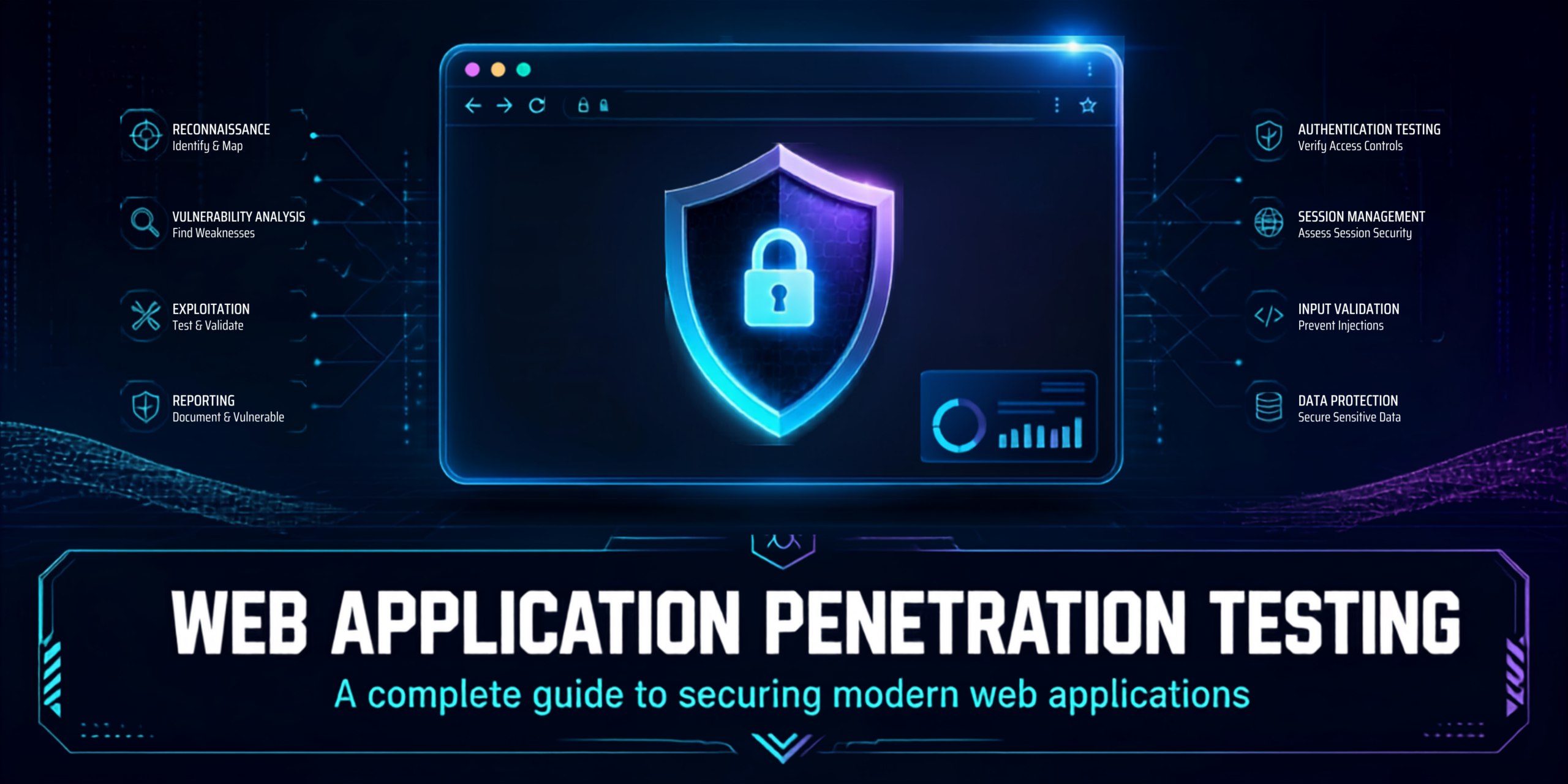
Web Application Penetration Testing follows a structured methodology to identify and validate security weaknesses.
Phase 1: Planning and Scope Definition
The penetration testing team defines:
- Target application
- Testing objectives
- Rules of engagement
- Timeline
- Authorization
- In-scope and out-of-scope assets
Phase 2: Information Gathering (Reconnaissance)
Security testers collect information about the application, including:
- Domain names
- Subdomains
- Technologies used
- Server details
- APIs
- Login pages
- Publicly exposed resources
Objective:
Understand the application’s attack surface.
Phase 3: Vulnerability Identification
Automated scanners and manual testing identify vulnerabilities such as:
- SQL Injection
- Cross-Site Scripting (XSS)
- Cross-Site Request Forgery (CSRF)
- Server-Side Request Forgery (SSRF)
- Remote Code Execution (RCE)
- Insecure File Uploads
- Broken Authentication
- Security Misconfigurations
- Directory Traversal
- Sensitive Data Exposure
Phase 4: Exploitation
Ethical hackers attempt to exploit identified vulnerabilities to determine:
- Severity
- Ease of exploitation
- Potential business impact
- Data accessibility
- Privilege escalation possibilities
Phase 5: Post Exploitation
The tester evaluates:
- User privilege escalation
- Administrative access
- Sensitive database access
- Session hijacking
- Lateral movement
- Persistence mechanisms
Phase 6: Reporting
A comprehensive report includes:
-
- Executive Summary
- Vulnerability Description
- Risk Rating
- CVSS Score
- Screenshots
- Proof of Concept (PoC)
- Business Impact
- Remediation Steps
Phase 7: Remediation and Retesting
After vulnerabilities are fixed:
- Security patches are applied.
- Secure coding practices are implemented.
- The penetration testing team retests the application to confirm that issues have been resolved.
Advantages
1. Identifies Critical Security Vulnerabilities
Discovers exploitable flaws before attackers can.
2. Protects Sensitive Data
Helps secure customer information, payment data, and confidential business records.
3. Improves Application Security
Strengthens authentication, authorization, session management, and input validation.
4. Supports Regulatory Compliance
Helps organizations comply with:
- PCI DSS
- ISO 27001
- GDPR
- HIPAA
- SOC 2
5. Reduces Business Risk
Minimizes the likelihood of cyberattacks, downtime, and financial losses.
6. Builds Customer Trust
Demonstrates a commitment to protecting user data and maintaining secure services.
7. Validates Security Controls
Confirms the effectiveness of firewalls, Web Application Firewalls (WAFs), and security configurations.
Disadvantages
Time-Intensive
Comprehensive testing requires careful planning and execution.
Requires Skilled Professionals
Manual testing demands experienced ethical hackers with knowledge of modern attack techniques.
Potential Impact on Production
Testing against live environments may affect application performance if not properly managed.
Cost
Professional penetration testing can be a significant investment, especially for complex applications.
Point-in-Time Assessment
Security assessments represent the application’s state at the time of testing and should be repeated regularly.
Tools
Reconnaissance
- Nmap
- Amass
- Subfinder
- theHarvester
- Maltego
Vulnerability Scanning
- Burp Suite Professional
- OWASP ZAP
- Nessus
- Nikto
- Acunetix
Exploitation
- Metasploit Framework
- SQLmap
- Commix
- XSStrike
- BeEF
Traffic Analysis
- Wireshark
- Fiddler
- Burp Suite Proxy
Password Testing
- Hydra
- John the Ripper
- Hashcat
Interview Questions
1. What is Web Application Penetration Testing?
Answer: It is an authorized security assessment that identifies and exploits vulnerabilities in web applications to evaluate their security.
2. What is the difference between Vulnerability Assessment and Penetration Testing?
Answer:
- Vulnerability Assessment identifies known security weaknesses.
- Penetration Testing validates whether those weaknesses can be exploited and assesses their impact.
3. What are common web application vulnerabilities?
Answer:
- SQL Injection
- Cross-Site Scripting (XSS)
- Cross-Site Request Forgery (CSRF)
- Broken Authentication
- Insecure Direct Object References (IDOR)
- Security Misconfiguration
- Server-Side Request Forgery (SSRF)
- Remote Code Execution (RCE)
4. What is the OWASP Top 10?
Answer: The OWASP Top 10 is a widely recognized list of the most critical security risks affecting web applications, maintained by the Open Worldwide Application Security Project (OWASP).
5. Which tools are commonly used for Web Application Penetration Testing?
Answer: Burp Suite, OWASP ZAP, SQLmap, Metasploit, Nmap, Nikto, Wireshark, Acunetix, and Hydra.
6. Why is retesting important after remediation?
Answer: Retesting confirms that identified vulnerabilities have been successfully fixed and ensures that no new security issues have been introduced.
Conclusion
Web Application Penetration Testing is a critical component of a robust cybersecurity strategy. By simulating real-world attacks, organizations can identify vulnerabilities before malicious actors exploit them. Regular testing helps improve application security, protect sensitive data, maintain regulatory compliance, and build customer confidence. Integrating penetration testing into the Secure Software Development Lifecycle (SSDLC) ensures that security remains a continuous process rather than a one-time activity.
CTA
Secure Your Web Applications with Expert Penetration Testing
Protect your web applications from evolving cyber threats with professional Web Application Penetration Testing services from SecureFlow Infotech.
Our Services Include:
- ✅ Comprehensive Web Application Security Assessments
- ✅ OWASP Top 10 Testing
- ✅ API Security Testing
- ✅ Authentication & Authorization Testing
- ✅ Detailed Reports with Proof of Concept and Remediation Guidance
- ✅ Experienced Certified Ethical Hackers
- ✅ Cybersecurity Training with Placement Support
📞 Contact Us Today:
+91 91339 19666 | +91 91884 94949