Introduction
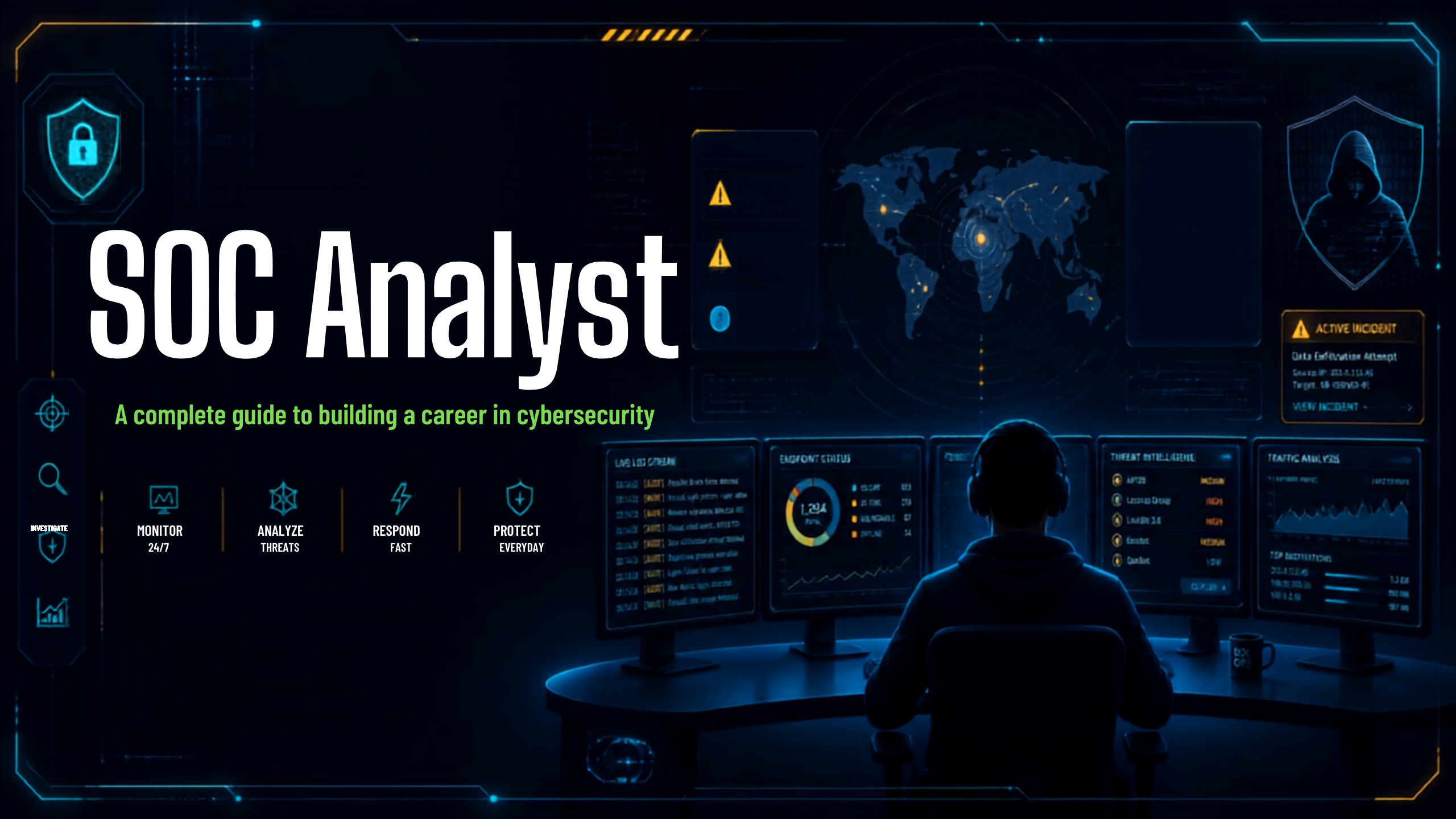
As cyberattacks continue to increase in frequency and sophistication, organizations need dedicated professionals to monitor, detect, analyze, and respond to security incidents around the clock. This responsibility falls on the Security Operations Center (SOC) and its frontline defenders—the SOC Analysts.
Definition
A SOC (Security Operations Center) Analyst is a cybersecurity professional responsible for continuously monitoring, detecting, investigating, and responding to security threats within an organization’s IT environment.
SOC Analysts use various security technologies such as SIEM, EDR, IDS/IPS, threat intelligence platforms, and monitoring tools to identify potential cyberattacks and minimize their impact.
Architecture
Users & Devices
|
+——————————-+
| Servers | Endpoints | Cloud |
+—————+—————+
|
Log Collection Agents
|
+——————+
| SIEM |
| Log Correlation |
| Alert Generation |
+——–+———+
|
+————+————+
| |
Threat Intelligence EDR/XDR
| |
+————+————+
|
SOC Analysts
|
Incident Response
|
Security Reporting
Working
Step 1: Data Collection
Step 2: Log Aggregation
Step 3: Threat Detection
Step 4: Alert Investigation
Step 5: Incident Response
Step 6: Documentation
Step 7: Continuous Monitoring
Advantages
Implementing a SOC team and employing SOC Analysts offers several benefits.
- 24/7 security monitoring.
- Faster threat detection.
- Reduced incident response time.
- Improved visibility into security events.
- Better compliance management.
- Enhanced threat intelligence utilization.
- Reduced risk of data breaches.
- Improved business continuity.
- Centralized security management.
- Proactive threat hunting capabilities.
Disadvantages
Despite its benefits, SOC operations have some challenges.
- High implementation costs.
- Large volume of alerts.
- Alert fatigue among analysts.
- Shortage of skilled professionals.
- Complex security environments.
- Continuous training requirements.
- False positives can consume resources.
- Advanced threats may evade detection.
Tools
| Tool | Purpose |
| Splunk | SIEM & Log Analysis |
| IBM QRadar | SIEM Platform |
| Microsoft Sentinel | Cloud-Native SIEM |
| ArcSight | Security Monitoring |
| LogRhythm | Threat Detection |
| CrowdStrike Falcon | Endpoint Detection & Response |
| Microsoft Defender XDR | Threat Detection |
| SentinelOne | Endpoint Security |
| Wireshark | Packet Analysis |
| Nmap | Network Discovery |
| VirusTotal | Malware Investigation |
| MISP | Threat Intelligence |
| TheHive | Incident Response |
| Cortex | Security Automation |
| Elastic Security |
Security Analytics |
Interview Questions
1. What is a SOC?
Answer:
A Security Operations Center (SOC) is a centralized team responsible for monitoring, detecting, analyzing, and responding to cybersecurity incidents.
2. What are the responsibilities of a SOC Analyst?
Answer:
- Monitor security events.
- Investigate alerts.
- Respond to incidents.
- Analyze logs.
- Perform threat hunting.
- Document security findings.
3. What is SIEM?
Answer:
Security Information and Event Management (SIEM) is a platform that collects, correlates, analyzes, and reports security events from multiple sources.
4. What is the difference between a True Positive and a False Positive?
Answer:
- True Positive: Legitimate security threat detected correctly.
- False Positive: Benign activity incorrectly flagged as malicious.
5. What is Incident Response?
Answer:
Incident Response is the process of identifying, containing, eradicating, and recovering from cybersecurity incidents.
6. What is Threat Hunting?
Answer:
Threat Hunting is the proactive process of searching for hidden threats that may not trigger automated alerts.
7. What is EDR?
Answer:
Endpoint Detection and Response (EDR) is a security solution that monitors endpoints for suspicious activities and helps respond to threats.
Conclusion
SOC Analysts are the frontline defenders of modern organizations, responsible for monitoring security events, investigating threats, and responding to incidents before they escalate into major breaches. As cyber threats continue to evolve, skilled SOC Analysts play a crucial role in maintaining business continuity, protecting sensitive data, and ensuring regulatory compliance. With strong technical skills, continuous learning, and hands-on experience, a SOC Analyst can build a highly rewarding and future-proof career in cybersecurity.
CTA
🚀 Become a Job-Ready SOC Analyst with SecureFlow Infotech
Kickstart your cybersecurity career with SecureFlow Infotech’s SOC & SIEM Training Program designed for students, freshers, and IT professionals.
What You’ll Learn
- Security Operations Center (SOC) Fundamentals
- SIEM Technologies (Splunk, QRadar, Microsoft Sentinel)
- Log Analysis & Correlation
- Incident Detection & Response
- Threat Hunting
- Malware Analysis Basics
- MITRE ATT&CK Framework
- Endpoint Security
- Real-Time SOC Use Cases
- Interview Preparation & Resume Building
Why Choose SecureFlow Infotech?
✅ Certified & Experienced Trainers
✅ Hands-On SOC Lab Environment
✅ Real-Time Security Scenarios
✅ Online & Offline Training
✅ Placement Assistance
✅ Flexible Batch Timings
✅ Industry-Oriented Curriculum
📞 Contact Us:
+91 91339 19666
+91 91884 94949
Join SecureFlow Infotech today and build a successful career as a SOC Analyst in the rapidly growing cybersecurity industry! 🔐🛡️