
Introduction
Attacks Introduction Modern web applications allow users to interact with websites through comments, search boxes, contact forms, chat applications, and social media platforms. While these features improve user experience, they can also become entry points for attackers if user input is not properly validated. One of the most common and dangerous web application vulnerabilities is Cross-Site Scripting (XSS).
Cross-Site Scripting (XSS) allows attackers to inject malicious scripts into trusted web pages. When unsuspecting users visit these compromised pages, the malicious scripts execute in their browsers, potentially leading to stolen cookies, session hijacking, account takeover, phishing attacks, and unauthorized actions.
Definition
Cross-Site Scripting (XSS) is a web application security vulnerability that enables attackers to inject malicious client-side scripts, usually JavaScript, into web pages viewed by other users.
Types of XSS
1. Stored XSS
The malicious script is permanently stored on the server (e.g., in a database) and delivered to users when they access the affected page.
2. Reflected XSS
The malicious script is reflected from the server in an immediate response, typically through URL parameters or form submissions.
3. DOM-Based XSS
The vulnerability exists in client-side JavaScript, where the browser modifies the Document Object Model (DOM) using untrusted input.
Architecture
Working
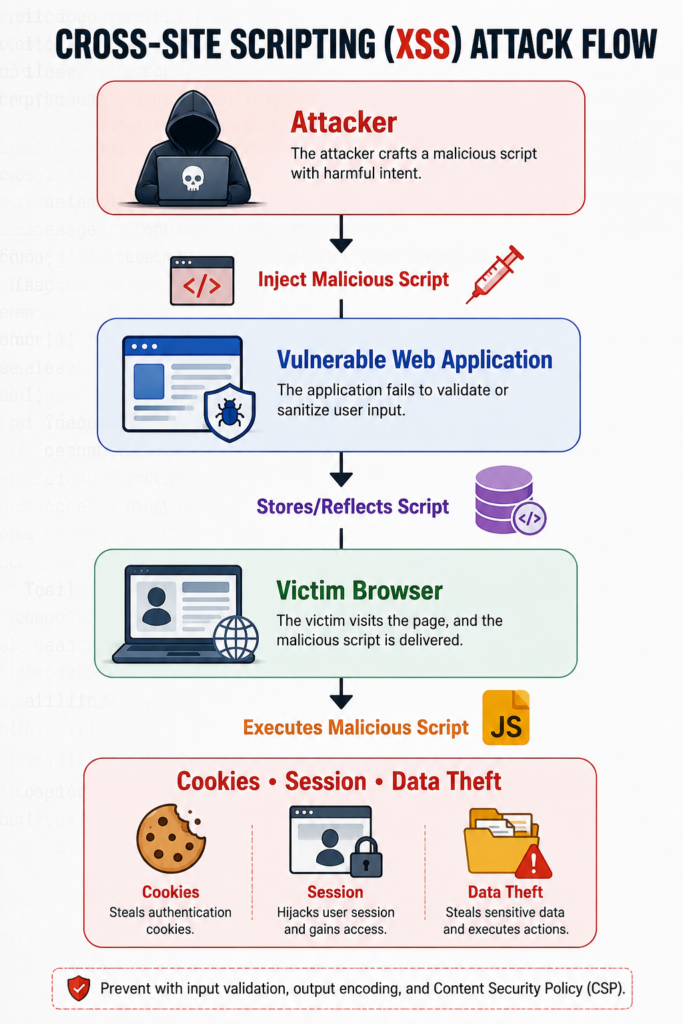
Cross-Site Scripting exploits applications that display user input without proper sanitization.
Step 1: Attacker Submits Malicious Input
Step 2: Application Stores or Reflects the Input
Step 3: Victim Visits the Page
Step 4: Browser Executes the Script
Step 5: Attacker Achieves Their Goal
Advantages
Note: Cross-Site Scripting is a security vulnerability and offers no legitimate benefits to attackers. The following advantages relate to understanding and testing XSS from a defensive cybersecurity perspective.
- Helps security professionals identify input validation flaws.
- Encourages secure coding practices.
- Improves awareness of browser-side security risks.
- Supports secure application development.
- Helps organizations meet security compliance requirements.
- Enhances penetration testing effectiveness.
Disadvantages
- Session hijacking
- Cookie theft
- Account takeover
- Phishing attacks
- Website defacement
- Data theft
- Loss of customer trust
- Financial losses
- Compliance violations
- Brand reputation damage
Tools
The following tools are commonly used to identify and test for XSS vulnerabilities:
| Tool | Purpose |
| Burp Suite | Manual web application security testing |
| OWASP ZAP | Open-source web vulnerability scanner |
| XSStrike | Advanced XSS detection and testing |
| DalFox | Fast XSS scanner |
| Nmap | Network scanning |
| Nikto | Web server vulnerability scanning |
| Acunetix | Automated web application security testing |
| Nessus | Vulnerability assessment |
| Wireshark | Network traffic analysis |
| Postman | API testing |
| Google Chrome DevTools | Inspect and debug client-side behavior |
Interview Questions
1. What is Cross-Site Scripting (XSS)?
Answer: XSS is a web application vulnerability that allows malicious scripts to execute in a victim’s browser through a trusted website.
2. What are the three main types of XSS?
Answer:
- Stored XSS
- Reflected XSS
- DOM-Based XSS
3. What is Stored XSS?
Answer: Stored XSS occurs when malicious scripts are permanently stored on the server and served to users whenever they access the affected page.
4. What is Reflected XSS?
Answer: Reflected XSS occurs when malicious input is immediately reflected in a server response without proper validation or encoding.
5. What is DOM-Based XSS?
Answer: DOM-Based XSS occurs entirely on the client side when JavaScript modifies the page using untrusted input.
6. How can XSS be prevented?
Answer:
- Validate user input
- Encode output
- Use Content Security Policy (CSP)
- Enable HTTPOnly cookies
- Sanitize HTML input
- Keep software updated
7. What is Content Security Policy (CSP)?
Answer: CSP is a browser security feature that restricts which scripts and resources can be loaded, helping reduce the impact of XSS attacks.
8. Why are HTTP Only cookies important?
Answer: HTTP Only cookies cannot be accessed by client-side JavaScript, reducing the risk of cookie theft through XSS.
9. Which OWASP category includes XSS?
Answer: In the OWASP Top 10 (2021), XSS is included under A03: Injection.
10. Which tools are commonly used to test XSS?
Answer: Burp Suite, OWASP ZAP, XSStrike, DalFox, and browser developer tools are commonly used during authorized security assessments.
Conclusion
Cross-Site Scripting (XSS) remains one of the most significant threats to web application security because it targets end users rather than backend systems. By understanding how XSS works and implementing defenses such as input validation, output encoding, Content Security Policy, secure cookies, and regular security testing, organizations can greatly reduce the risk of successful attacks. For developers, security analysts, and ethical hackers, mastering XSS is an essential step toward building and maintaining secure web applications.
🚀 Master Cross-Site Scripting (XSS) & Web Application Security with Secure Flow Infotech!
Take your cybersecurity career to the next level with Secure Flow Infotech’s Cybersecurity (VAPT) Training Program and gain hands-on experience in identifying and mitigating XSS and other OWASP Top 10 vulnerabilities.
What You’ll Learn
- Cross-Site Scripting (Stored, Reflected & DOM-Based XSS)
- OWASP Top 10 (2021)
- Web Application Penetration Testing
- Burp Suite & OWASP ZAP
- SQL Injection, CSRF & SSRF Testing
- API Security Testing
- Secure Coding Best Practices
- Real-Time VAPT Projects
- Resume Building & Mock Interviews
- Placement Assistance
Why Choose Secure Flow Infotech?
- Industry-Experienced Trainers
- Practical Lab Sessions
- Live Projects & Case Studies
- Online & Offline Training
- Flexible Batch Timings
- Career Guidance & Certification Support
📞 Contact Us: +91 91339 19666 | +91 91884 94949
Secure Flow Infotech – Secure Solutions. Smart Flow. Seamless Future