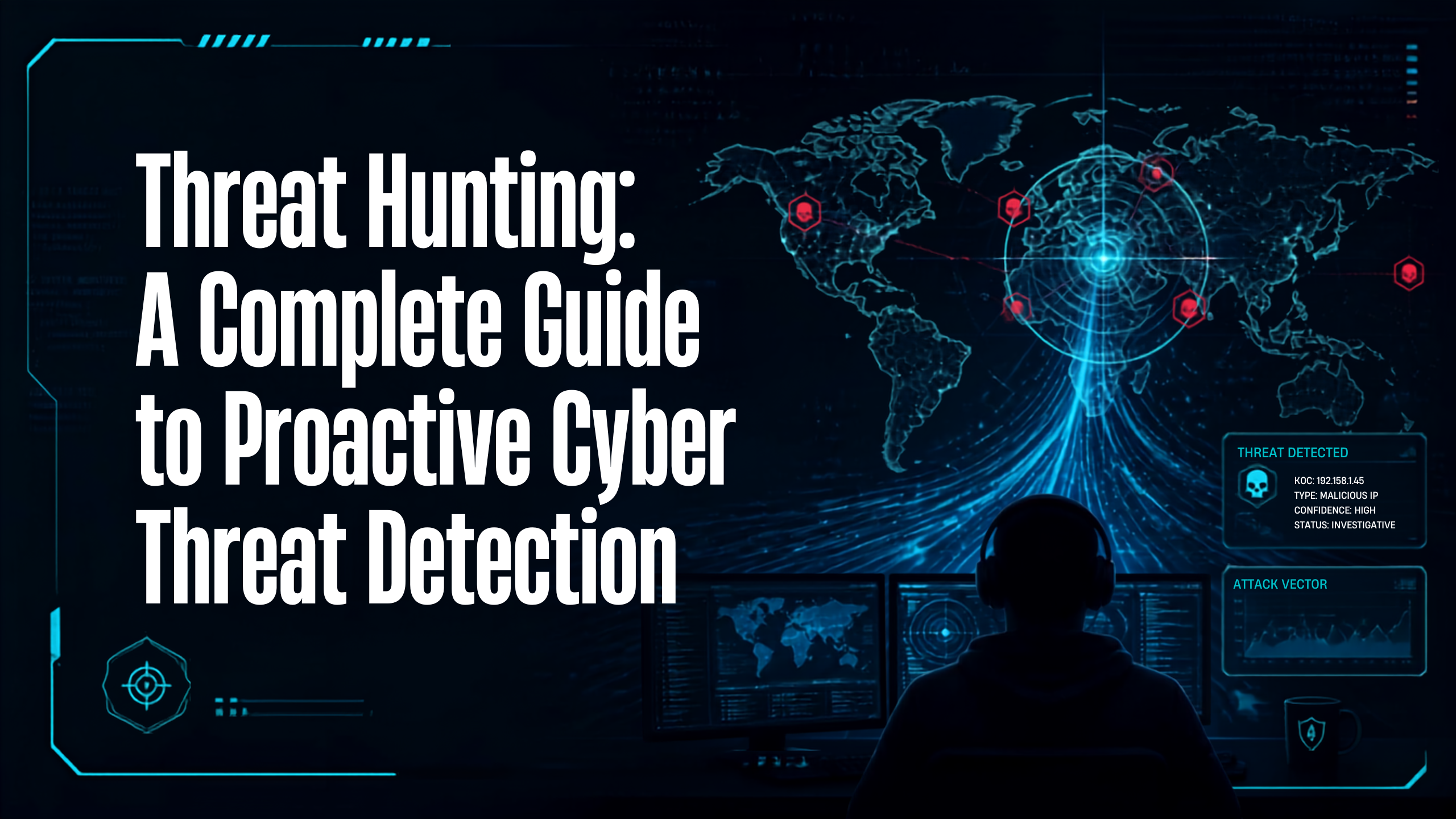
Threat Hunting: A Complete Guide to Proactive Cyber Threat Detection
Introduction
As cyberattacks become more sophisticated, organizations can no longer rely solely on traditional security tools such as firewalls, antivirus software, or automated alerts. Modern attackers often use advanced techniques to remain hidden within networks for weeks or even months, making them difficult to detect through conventional security monitoring.
Definition
Threat Hunting is a proactive cybersecurity process of continuously searching for hidden cyber threats, malicious activities, and security anomalies within an organization’s IT environment before they cause significant damage.
Unlike traditional security monitoring, which reacts to alerts generated by security tools, threat hunting assumes that attackers may already be present in the environment and actively looks for evidence of compromise.
Architecture
Data Sources
——————————————————-
Endpoints | Servers | Firewalls | Cloud | Email
Applications | Active Directory | IDS/IPS | Network
——————————————————-
|
Log Collection
|
SIEM / Data Lake
|
+——-+———+
| |
Threat Intelligence Behavioral Analytics
| |
+———–+————+
|
Threat Hunting Team
|
Investigation & Validation
|
Incident Response Team
|
Remediation & Monitoring
Working
Step 1: Develop a Hunting Hypothesis
Step 2: Collect Security Data
Step 3: Analyze the Data
Step 4: Correlate Events
Step 5: Validate Findings
Step 6: Respond to the Threat
Step 7: Improve Detection
Advantages
Threat hunting provides significant benefits for organizations.
- Proactively identifies hidden threats.
- Reduces attacker dwell time.
- Detects sophisticated attacks that evade automated tools.
- Improves incident response readiness.
- Enhances threat intelligence capabilities.
- Strengthens SOC effectiveness.
- Minimizes the impact of cyberattacks.
- Improves overall security visibility.
- Supports regulatory compliance.
- Builds organizational resilience against advanced threats.
Disadvantages
Despite its benefits, threat hunting also presents challenges.
- Requires highly skilled cybersecurity professionals.
- Can be time-consuming and resource-intensive.
- Generates large volumes of data to analyze.
- May require expensive security tools.
- Continuous tuning and process improvement are necessary.
- Advanced threats may still evade detection if visibility is limited.
Tools
| Tool | Purpose |
| Microsoft Sentinel | Cloud-native SIEM and threat hunting |
| Splunk Enterprise Security | Log analysis and threat detection |
| IBM QRadar | Security analytics and event correlation |
| CrowdStrike Falcon | Endpoint Detection and Response (EDR) |
| Microsoft Defender for Endpoint | Endpoint monitoring and investigation |
| Wazuh | Open-source SIEM/XDR |
| Elastic Security | Threat detection and analytics |
| Zeek | Network security monitoring |
| Wireshark | Network packet analysis |
| VirusTotal | Malware and IOC analysis |
| MITRE ATT&CK Navigator | Mapping attacker tactics and techniques |
| YARA | Malware identification through custom rules |
| TheHive | Incident response and case management |
| Cortex XSOAR | Security orchestration and automation |
Interview Questions
1. What is Threat Hunting?
Answer:
Threat hunting is the proactive process of searching for hidden cyber threats within an organization’s environment before they are detected by automated security tools.
2. What is the difference between Threat Hunting and Incident Response?
Answer:
- Threat Hunting: Proactively searches for hidden threats before an alert is generated.
- Incident Response: Reactively investigates and responds after a security incident has been detected.
3. What is a Threat Hunting Hypothesis?
Answer:
A hypothesis is an assumption about potential malicious activity that guides a threat hunting investigation, often based on intelligence or observed behavior.
4. Which framework is commonly used during Threat Hunting?
Answer:
The MITRE ATT&CK Framework is widely used to understand attacker tactics, techniques, and procedures (TTPs) and to guide hunting activities.
5. What are Indicators of Compromise (IOCs)?
Answer:
IOCs are pieces of forensic evidence, such as malicious IP addresses, file hashes, domains, or registry changes, that indicate a system may have been compromised.
6. Which skills are important for a Threat Hunter?
Answer:
- Log Analysis
- Networking
- Operating Systems
- Malware Analysis
- Threat Intelligence
- SIEM
- EDR/XDR
- Scripting (Python or PowerShell)
- Analytical Thinking
- Knowledge of MITRE ATT&CK
Conclusion
Threat hunting is a proactive cybersecurity practice that enables organizations to detect advanced threats before they escalate into major security incidents. By combining threat intelligence, behavioral analytics, SIEM, EDR, and expert analysis, threat hunters can uncover hidden attacker activity that traditional security tools may miss. As cyber threats continue to evolve, threat hunting has become a critical capability for modern Security Operations Centers (SOCs), helping organizations reduce attacker dwell time, improve incident response, and strengthen their overall cyber resilience.
CTA
🚀 Become a Threat Hunting Expert with SecureFlow Infotech
Advance your cybersecurity career with SecureFlow Infotech’s SOC, SIEM & Threat Hunting Training Program. Learn how to proactively detect, investigate, and respond to sophisticated cyber threats using industry-leading tools and real-world attack scenarios.
What You’ll Learn
- Threat Hunting Fundamentals
- SIEM (Microsoft Sentinel & Splunk)
- Endpoint Detection & Response (EDR)
- Threat Intelligence
- MITRE ATT&CK Framework
- Log Analysis & Event Correlation
- Malware Detection
- Incident Response
- Real-Time SOC Labs
- Hands-on Threat Hunting Exercises
Why Choose SecureFlow Infotech?
- ✅ Certified & Experienced Trainers
- ✅ Practical Hands-on Labs
- ✅ Real-Time Security Scenarios
- ✅ Industry-Oriented Curriculum
- ✅ Placement Assistance
- ✅ Interview Preparation
- ✅ Online & Offline Training
- ✅ Flexible Batch Timings
📞 Contact Us:
+91 91339 19666
+91 91884 94949
Join SecureFlow Infotech today and gain the practical skills needed to become a professional Threat Hunter, capable of identifying and stopping advanced cyber threats before they impact your organization.