1. Introduction
Software applications are becoming more complex, and cyber threats are increasing every year. Organizations need professionals who understand both software delivery and cybersecurity. DevSecOps addresses this requirement by combining development, security and operations into one continuous process. If you are interested in cybersecurity, cloud computing, automation or software development, understanding DevSecOps can open up several career possibilities.
Definition
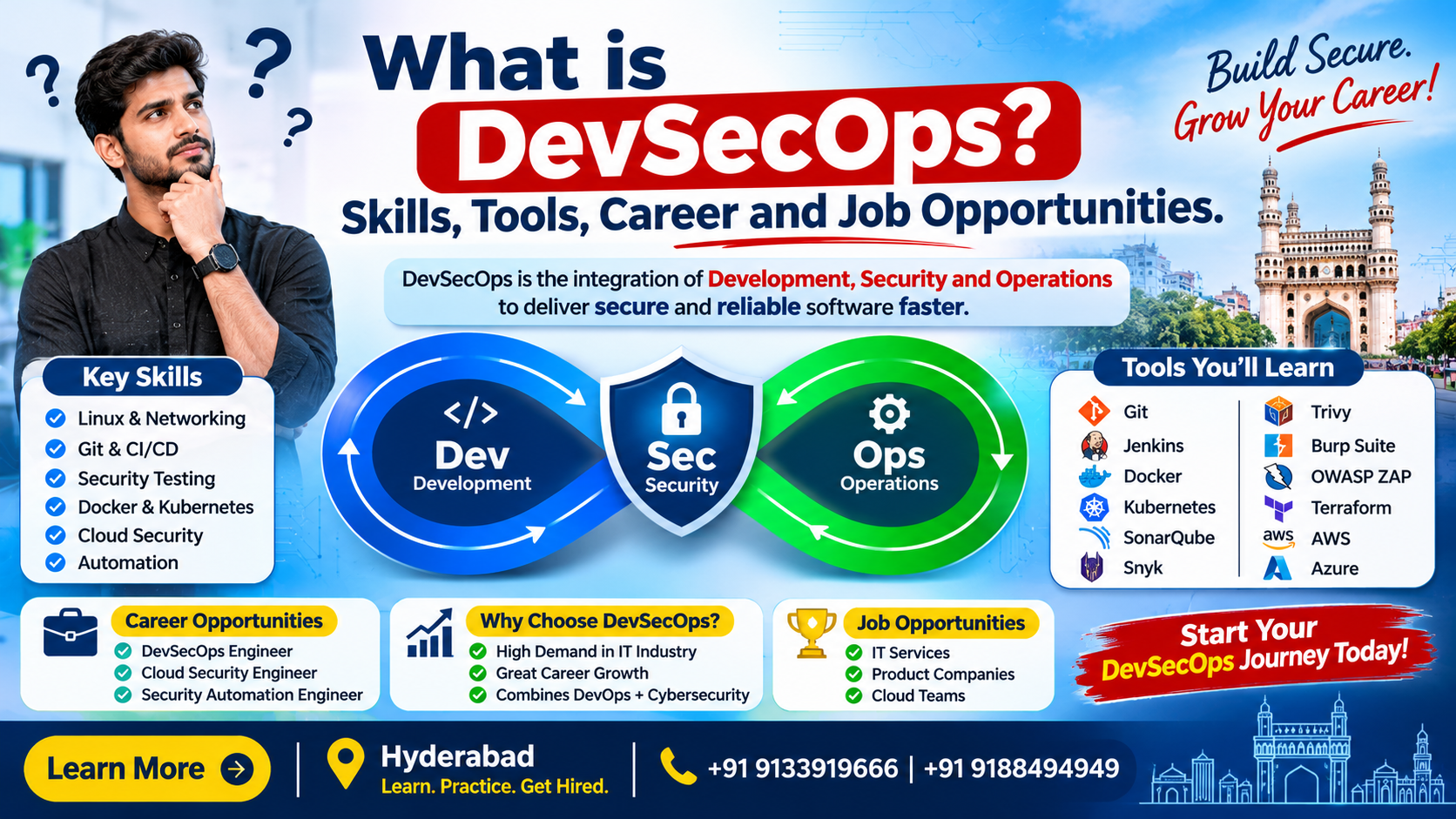
DevSecOps is an approach that integrates security practices into every stage of the software development lifecycle.
Its three major components are:
- Development: Writing and maintaining application code.
- Security: Identifying, preventing and fixing vulnerabilities.
- Operations: Managing deployment, infrastructure and monitoring.
DevSecOps encourages shared security responsibility across teams.
DevSecOps Architecture
The architecture generally includes:
- Developers and source code repositories.
- Build automation.
- Automated security scanning.
- Testing environments.
- Container registries.
- Cloud infrastructure.
- Deployment automation.
- Security monitoring
All these components work together to deliver secure software.
Working
DevSecOps works by introducing security at each development stage.
Example workflow:
- A developer writes code.
- Code is pushed to GitHub.
- Jenkins triggers the CI pipeline.
- SonarQube performs code analysis.
- Snyk checks dependencies.
- Trivy scans container images.
- Security findings are fixed.
- The application is deployed to Kubernetes.
- Monitoring tools continuously track the application.
This workflow helps organizations identify risks before they reach production.
Advantages
- Better application security.
- Continuous security testing.
- Faster vulnerability identification.
- Reduced manual testing.
- Improved collaboration.
- Secure cloud deployment.
- Better software quality.
- Increased visibility into software risks.
Disadvantages
- Requires technical expertise.
- Implementation can be expensive.
- Security automation requires maintenance.
- Tool integration can be challenging.
- False positives can affect developer productivity.
- Teams need continuous training.
Best Practices
- Adopt a shift-left security approach.
- Implement automated code scanning.
- Use secure coding standards.
- Protect source code repositories.
- Scan open-source dependencies.
- Secure CI/CD pipelines.
- Implement container security.
- Monitor cloud environments.
- Maintain an effective vulnerability management process.
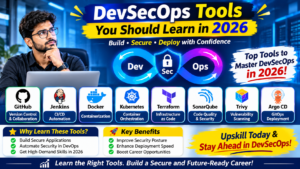
Tools
| Technology | Tools |
| Programming | Python, Java, Bash |
| Version Control | Git, GitHub |
| CI/CD | Jenkins, GitLab CI |
| Code Security | SonarQube, Semgrep |
| Dependency Security | Snyk |
| Web Security | Burp Suite, OWASP ZAP |
| Container Security | Trivy |
| Infrastructure Security | Chekhov |
| Orchestration | Kubernetes |
| Monitoring | Prometheus, Grafana |
Interview Questions
Q1. What are the three pillars of DevSecOps?
Development, Security and Operations.
Q2. What is shift-left security?
It means introducing security practices early in the software development lifecycle.
Q3. What skills are required for DevSecOps?
Git, Linux, scripting, CI/CD, Docker, Kubernetes, cloud technologies and application security fundamentals.
Q4. What is vulnerability scanning?
It is the process of identifying known security weaknesses in applications, systems or dependencies.
Q5. What is container security?
It involves securing container images, configurations, registries and running container environments.
Q6. What does a DevSecOps Engineer do?
A DevSecOps Engineer integrates security testing into CI/CD pipelines, secures cloud infrastructure and helps development teams remediate vulnerabilities.
Conclusion
DevSecOps is a combination of software engineering, automation and cybersecurity.
Professionals who understand both development workflows and security principles can contribute significantly to modern software organizations.
Building hands-on experience with industry-relevant tools is an important step towards entering this career.
Interested in becoming a DevSecOps professional?
Join SecureFlow Infotech to learn DevSecOps concepts, security automation, CI/CD integration, Docker, Kubernetes and cloud security through practical training.
Contact: +91 9133919666 | +91 9188494949
Website: https://secureflowinfotech.com/