
DevSecOps Course in Hyderabad, DevSecOps Training for Beginners.
Introduction
The demand for secure software development is increasing as organizations adopt cloud computing, automation, microservices and continuous deployment. Traditional software development often treats security as a final step. However, modern organizations cannot afford to wait until the end of development to identify vulnerabilities. This is where DevSecOps comes into the picture. DevSecOps combines Development, Security and Operations to ensure that security is integrated throughout the software development lifecycle. For students, freshers and IT professionals looking to build a career in cybersecurity and cloud technologies, learning DevSecOps can be a valuable career investment. Hyderabad has a growing technology and IT services ecosystem, making it an attractive location to explore DevSecOps training and career opportunities.
What is DevSecOps ?
DevSecOps stands for Development, Security and Operations. It is a methodology that integrates security practices into the DevOps workflow. Instead of performing security testing only before deployment, DevSecOps introduces automated security checks during:
- Software development.
- Source code management.
- Application building.
- Testing.
- Deployment.
- Production monitoring.
The main objective is to identify and fix security vulnerabilities as early as possible.
Architecture:
A typical DevSecOps architecture contains the following components:
- Developer: Writes and modifies application code.
- Git Repository: Stores application source code.
- CI/CD Pipeline: Automates building, testing and deployment.
- SAST: Identifies insecure coding practices.
- SCA: Identifies vulnerable third-party dependencies.
- Container Security: Scans Docker images.
- Infrastructure Security: Checks cloud infrastructure configurations.
- Deployment: Deploys secure applications.
- Monitoring: Continuously monitors applications and infrastructure.
Working of DevSecOps
A DevSecOps workflow generally follows these steps:
- Developers write application code.
- Code is uploaded to GitHub or GitLab.
- CI/CD tools automatically trigger pipeline execution.
- SAST tools scan the source code.
- SCA tools identify vulnerable libraries.
- Container scanning tools check Docker images.
- Security findings are reviewed and remediated.
- Approved builds are deployed to cloud environments.
- Monitoring tools track application behaviour.
Security becomes a continuous activity rather than a one-time process.
Advantages of DevSecOps
- Early identification of vulnerabilities.
- Improved application security.
- Faster software delivery.
- Reduced security remediation costs.
- Better collaboration between development and security teams.
- Automated security testing.
- Improved compliance and risk management.
- Better cloud and container security.
Disadvantages of DevSecOps
- Initial implementation can be complex.
- Requires knowledge of multiple technologies.
- Security tools can generate false positives.
- Pipeline execution may take additional time.
- Requires continuous learning and maintenance.
- Organizations may face resistance when introducing new security practices.
Best Practices
- Implement security from the beginning of development.
- Automate security testing in CI/CD pipelines.
- Scan source code regularly.
- Protect credentials and API keys.
- Perform container vulnerability assessments.
- Follow least-privilege access.
- Maintain secure cloud configurations.
- Monitor and remediate vulnerabilities continuously.
Tools to Learn
| Category | Tools |
| Version Control | Git, GitHub, GitLab |
| CI/CD | Jenkins, GitHub Actions |
| SAST | SonarQube, Semgrep, Checkmarx |
| SCA | Snyk, OWASP Dependency-Check |
| DAST | OWASP ZAP, Burp Suite |
| Container Security | Trivy, Aqua |
| Infrastructure Security | Checkov, Terraform |
| Container Orchestration | Docker, Kubernetes |
| Cloud | AWS, Azure |
DevSecOps Interview Questions
Q1. What is DevSecOps?
DevSecOps integrates security into the development and operations lifecycle to identify and prevent vulnerabilities continuously.
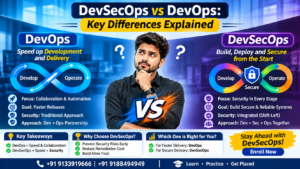
Q2. What is the difference between DevOps and DevSecOps?
DevOps focuses on collaboration and automation between development and operations. DevSecOps adds security throughout the workflow.
Q3. What is SAST?
Static Application Security Testing analyses source code without executing the application.
Q4. What is DAST?
Dynamic Application Security Testing examines a running application to identify security vulnerabilities.
Q5. What is SCA?
Software Composition Analysis identifies security vulnerabilities and licensing risks in third-party dependencies.
Q6. What is a CI/CD pipeline?
It is an automated workflow used to build, test and deploy software.
Conclusion
DevSecOps is an important part of modern software development. Learning Git, Jenkins, Docker, Kubernetes, cloud technologies and security testing tools can help beginners develop the technical foundation required for DevSecOps roles.
The best way to learn DevSecOps is through practical projects, real-world pipeline implementation and continuous practice.
Start Your DevSecOps Career
Want to become a DevSecOps Engineer?
Join SecureFlow Infotech and develop practical knowledge of DevSecOps concepts, security tools, CI/CD pipelines, cloud security and automation.
Explore our DevSecOps training programs and take your first step towards a career in cybersecurity and DevOps.
Contact: +91 9133919666 | +91 9188494949
Website: https://secureflowinfotech.com/